A brief overview of the meaning, history, and key facts about the national flag of Bhutan.

Flag of Bhutan
The national flag of Bhutan features a white dragon stretched diagonally across a field divided into two triangles. The yellow upper half represents the secular authority of the King of Bhutan (Druk Gyalpo), while the orange lower half symbolizes the country’s deep-rooted Buddhist spiritual traditions, particularly the Drukpa Kagyu and Nyingma schools. The diagonal division of the flag reflects the harmony between Bhutan’s secular governance and its spiritual heritage. The white dragon represents the purity and loyalty of the Bhutanese people.
Printable Bhutan Flag (PNG Download)
Interesting facts about Bhutan’s flag
1. The white dragon, known as Druk, gives Bhutan its traditional name Druk Yul, meaning “Land of the Thunder Dragon.”
2. The dragon holds jewels in its claws, symbolizing the wealth and security of the nation, while its fierce expression conveys the strength and protection of the kingdom.
3. On early flags the dragon appeared more horizontal in the center, but it was later repositioned to stretch across the diagonal division so it would not appear to face downward when the flag hung loosely.
4. Early versions of the Bhutanese flag featured a green dragon, reflecting traditional references to yu druk ngon ma, meaning “turquoise dragon.” The dragon was changed to white in 1956.
5. In early versions of the flag, the lower triangle was red instead of orange. The color was changed to orange around 1968–1969, producing the modern design.
Explore more about Bhutan:
Evolution of Bhutan’s flag
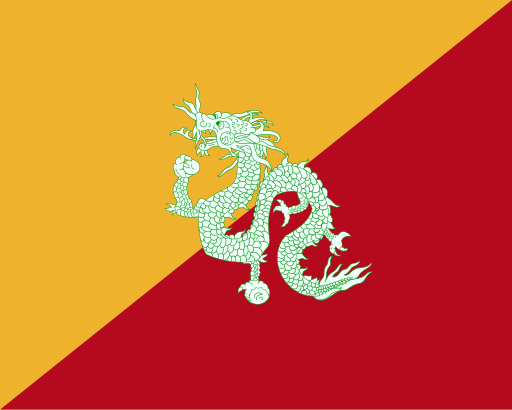
First national flag of Bhutan (1949)
The flag featured a green dragon centered on a diagonally divided field of yellow and red.
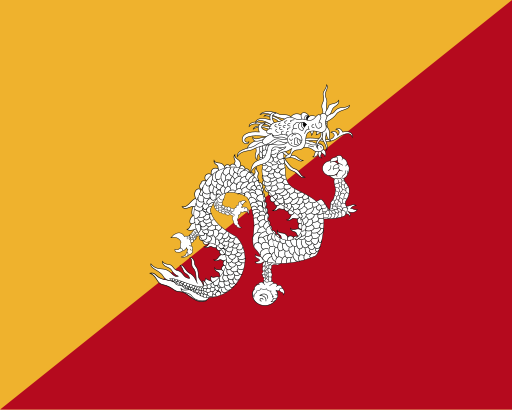
Revised flag with white dragon (1956)
In 1956, the dragon was changed from green to white while the overall layout remained largely the same.
History of Bhutan’s flag
Early development
The design of Bhutan’s national flag was created in 1947 by Mayum Choying Wangmo Dorji at the request of King Jigme Wangchuck.
The flag was first used publicly in 1949 during the signing of the Indo-Bhutan Treaty, marking an important moment in Bhutan’s diplomatic relations with India.
Design modifications
During the 1950s and 1960s, several changes were made to the flag’s design.
The dragon was changed from green to white, and the dragon’s position was later adjusted to extend along the diagonal division of the flag.
These changes helped improve the appearance of the flag when flown.
Adoption of the modern flag (1969)
Further modifications were made in the late 1960s under King Jigme Dorji Wangchuck.
The lower half of the flag was changed from red to orange, and the flag’s proportions were adjusted to match the rectangular format used today.
The modern design has remained unchanged since 1969.
Flag regulations
In 1972, the National Assembly of Bhutan adopted official rules defining the design, sizes, and proper display of the national flag, formalizing its use as one of the country’s national symbols.

Caitriona Maria is an education writer and owner of The Facts Institute. With seven years of teaching experience and a background in educational content, she specialises in creating clear reference resources about countries, geography and global topics.