A brief overview of the meaning, history, and key facts about the national flag of Sri Lanka.
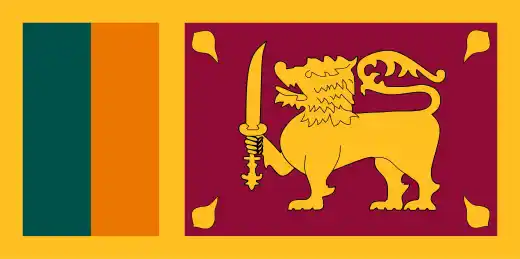
Flag of Sri Lanka
Adopted in 1972, the national flag of Sri Lanka features a lion holding a sword, which was the central symbol on the royal standard. The lion represents the Sinhalese people, while the sword symbolizes the sovereignty of the country. Bo leaves appear in the four corners of the flag, reflecting Buddhist influence and representing the virtues of kindness, friendliness, happiness, and equanimity. The vertical orange stripe represents the Tamil minority, while the green stripe represents the Muslim minority.
Printable Sri Lanka Flag (PNG Download)
Interesting facts about Sri Lanka’s flag
1. The Sri Lankan flag is based on the civil standard of the last king of Sri Lanka, Sri Wickrama Rajasingha.
2. The lion on Sri Lanka’s flag contains several layers of meaning. Its curly hair represents religious observance, wisdom, and meditation, while the beard symbolizes purity of speech and the nose represents intelligence. The two front paws are said to represent purity in handling wealth.
3. The sword’s handle symbolizes the four natural elements—water, fire, air, and earth.
4. The yellow border surrounding the flag represents the other minority races of Sri Lanka.
5. The maroon background of the flag represents the other minority religions in the country.
Evolution of Sri Lanka’s flag
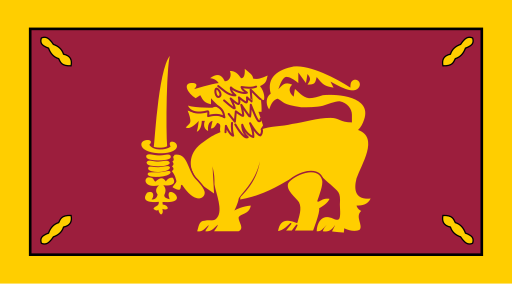
Flag of the Dominion of Ceylon (1948–1951)
Derived from the royal standard of the Kingdom of Kandy, the design featured a golden lion holding a sword on a maroon background, surrounded by a yellow border with four spearhead symbols in the corners.
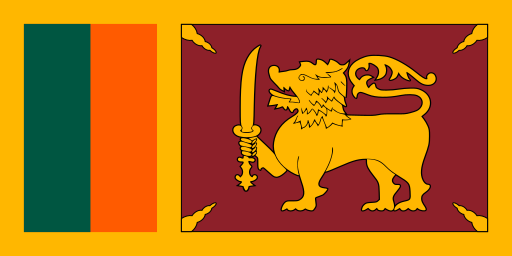
Flag of the Dominion of Ceylon (1951–1972)
Two vertical stripes, orange and green, were added, representing the Tamil and Muslim communities. The lion emblem and spearhead symbols remained unchanged.
History of Sri Lanka’s flag
Origins of the lion symbol
The lion symbol has ancient roots in Sri Lankan history. A banner featuring a lion holding a sword was associated with the Sinhalese kingdoms and is traditionally linked to King Dutugemunu, who is said to have carried a lion banner during his campaign against the South Indian ruler Elara in 162 BC.
Kandyan Kingdom flag
The lion emblem later appeared on the royal standard of the Kingdom of Kandy, used during the reign of Sri Wickrama Rajasingha.
Although the British replaced this flag with the Union Flag after annexing the kingdom in 1815, the Kandyan royal standard later inspired the design of Sri Lanka’s modern national flag.
British colonial period
In 1815 the Kandyan Convention ended the rule of the last native monarch. The royal standard was replaced by the Union Flag during British colonial rule, and the original Lion Flag was taken to England and kept at the Royal Hospital Chelsea.
Independence and adoption of the national flag
As the independence movement grew in the early twentieth century, the original Lion Flag was rediscovered and publicized by Sri Lankan nationalists.
In 1948 the Lion Flag was adopted as the national flag of the newly independent Dominion of Ceylon.
Later modifications
The design was later modified in the early years after independence with the addition of two vertical stripes representing minority communities.
In 1972 the flag was updated again when Sri Lanka became a republic, replacing the spearheads in the corners with bo leaves.

Caitriona Maria is an education writer and owner of The Facts Institute. With seven years of teaching experience and a background in educational content, she specialises in creating clear reference resources about countries, geography and global topics.