A brief overview of the meaning, history, and key facts about the national flag of South Sudan.
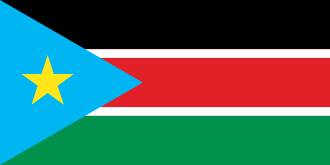
Flag of South Sudan
The flag of South Sudan features three horizontal stripes of black, red, and green, separated by thin white stripes, along with a sky-blue triangle at the hoist containing a yellow five-pointed star. The colors carry symbolic meanings tied to the nation’s history and identity. Black represents the people of South Sudan, red symbolizes the blood shed during the long struggle for independence, and green reflects the country’s fertile land and potential. The white stripes stand for peace.
Printable South Sudan Flag (PNG Download)
Interesting facts about South Sudan’s flag
1. The flag existed before the country itself. South Sudan began using this flag in 2005, six years before independence. It was officially adopted on 9 July 2011, when the country became independent from Sudan.
2. The horizontal stripes and color scheme resemble the Kenyan flag and reflect broader pan-African symbolism often used in African national flags.
3. Both Sudan and South Sudan use black, red, green, and white, but the meaning of the colors differs between the two countries.
4. South Sudan’s flag uses six colors. It is one of only a few national flags in the world that incorporate six colors in their main design.
5. In August 2023, South Sudan’s Media Authority clarified that the correct version must use a light sky-blue triangle and an upright yellow star, making alternative versions incorrect.
6. The blue triangle represents the waters of the Nile River, an essential source of life for the region, while the yellow star symbolizes the unity of the states of South Sudan.
Explore more about South Sudan:
Evolution of South Sudan’s flag
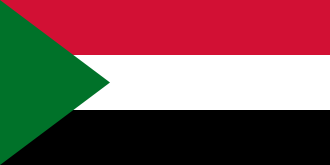
Flag of Sudan (used in South Sudan, 1970–2011)
Before independence, South Sudan was part of Sudan and used the national flag of Sudan, which features horizontal stripes of red, white, and black with a green triangle at the hoist.
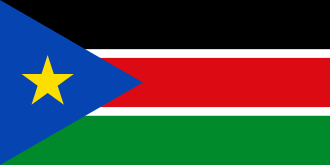
Flag of Southern Sudan (2005–2011)
Southern Sudan gained autonomy and adopted a flag featuring black, red, and green stripes separated by white lines, along with a blue triangle and yellow star.

Flag of South Sudan (2011–2023)
During this period, slightly different versions of the flag were commonly used, particularly regarding the shade of blue and the orientation of the yellow star.
History of South Sudan’s flag
Peace agreement and the creation of a regional flag
In January 2005, a peace agreement was signed between the Government of Sudan and the Sudan People’s Liberation Movement (SPLM), ending the Second Sudanese Civil War. The agreement granted Southern Sudan political autonomy and allowed it to use its own flag.
The design chosen closely resembled the flag used by the Sudan People’s Liberation Movement, which had led the struggle for autonomy and independence.
Independence of South Sudan (2011)
A referendum held in January 2011 resulted in an overwhelming vote in favor of independence. Following the successful vote, South Sudan officially became an independent country on 9 July 2011.
The autonomous regional flag was retained and formally became the national flag of the Republic of South Sudan.
Standardization of the flag (2023)
For many years, different versions of the flag appeared in public use, particularly with variations in the shade of blue and the orientation of the yellow star.
In August 2023, the South Sudan Media Authority issued official guidance confirming the correct design. The triangle must be light sky blue, and the yellow star must point straight upward. The directive was introduced to ensure consistency in official reproductions of the national flag.

Caitriona Maria is an education writer and owner of The Facts Institute. With seven years of teaching experience and a background in educational content, she specialises in creating clear reference resources about countries, geography and global topics.