A brief overview of the meaning, history, and key facts about the national flag of Togo.

Flag of Togo
Adopted in 1960, the national flag of Togo consists of five horizontal stripes of green and yellow with a red square in the upper hoist corner containing a white five-pointed star. The green stripes represent forests, agriculture, and hope. The yellow stripes symbolize faith in the nation, the country’s mineral resources, and the collective destiny of the Togolese people. The red square represents the blood shed by those who fought for independence and those who died defending democracy and the rule of law. The white star symbolizes peace, light and intelligence.
Printable Togo Flag (PNG Download)
Interesting facts about Togo’s flag
1. The national flag of Togo was designed by Professor Paul Ahyi, an artist and sculptor.
2. Togo officially adopted its flag on 27 April 1960, the same day the country gained independence.
3. The flag contains five horizontal stripes, with the first, third, and fifth stripes colored green.
4. The white star in the red canton symbolizes peace, light, and intelligence.
5. Some interpretations state that the five stripes represent the five regions of Togo.
Explore more about Togo:
Evolution of Togo’s flag
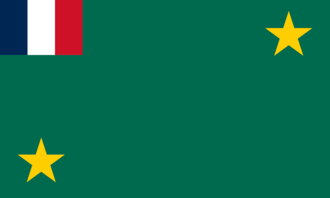
Flag of French Togoland (1956–1960)
The flag design featured a green field with the French tricolor in the canton and two yellow five-pointed stars, representing the northern savannas and southern coastal plains of the country. The green field symbolized agriculture, hope, and youth.
Yue, CC BY-SA 3.0, via Wikimedia Commons.
History of Togo’s flag
Colonial period
Togo was originally a German colony known as German Togoland, established in 1884. During the First World War, British and French forces invaded the territory in 1914 and Germany surrendered shortly afterward.
Following the war, the territory was divided between Britain and France under a League of Nations mandate. The western portion was administered by Britain as part of the Gold Coast, while the eastern portion became French Togoland.
Autonomy within the French Union
After the Second World War, the United Nations trusteeship system required France to guide Togoland toward self-government. On 24 August 1956, French Togoland became an autonomous republic within the French Union.
At this time a new territorial flag was introduced featuring a green background, the French tricolor in the canton, and two yellow stars representing the country’s geographical regions.
In 1957, the British-administered western part of Togoland joined the newly independent state of Ghana.
Independence and adoption of the national flag
Togo became fully independent from France on 27 April 1960.
Shortly before independence, Togolese artist Paul Ahyi designed the new national flag. His design was officially adopted on the day independence was proclaimed.
The flag uses five horizontal stripes of green and yellow with a red square containing a white star in the canton. The colors reflect pan-African symbolism and national ideals associated with unity, hope, independence, and peace.

Caitriona Maria is an education writer and owner of The Facts Institute. With seven years of teaching experience and a background in educational content, she specialises in creating clear reference resources about countries, geography and global topics.