A brief overview of the meaning, history, and key facts about the national flag of Gambia.
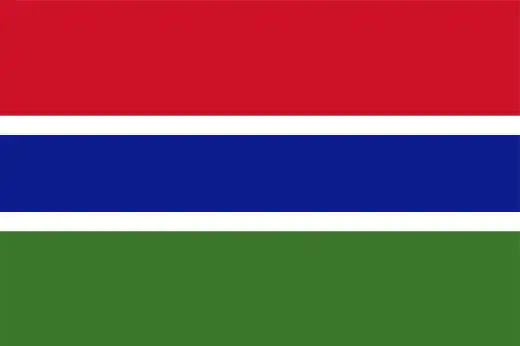
Flag of The Gambia
Adopted in 1965, the national flag of The Gambia consists of three horizontal stripes of red, blue, and green separated by two thin white bands. The blue stripe represents the Gambia River, which runs through the center of the country. Red symbolizes the sun and the savanna landscape, while green represents the forests and agricultural land. The white stripes symbolize unity and peace.
Printable The Gambia Flag (PNG Download)
Interesting facts about The Gambia’s flag
1. The Gambia adopted its national flag on 18 February 1965, the same day the country gained independence from Britain.
2. The same color combination also appears in the Gambian coat of arms. This was approved by the English College of Arms, the heraldic advisers to Queen Elizabeth.
3. Unlike many African national flags, the design does not represent any political party, and its colors were chosen for geographic and cultural symbolism.
4. The flag remained unchanged during the Senegambia Confederation (1982–1989) between The Gambia and Senegal.
Explore more about The Gambia:
Evolution of Gambia’s flag
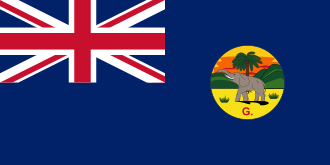
Flag of the Gambia Colony and Protectorate (1889–1965)
During British colonial rule, the territory used a British Blue Ensign with a badge representing the colony. The badge featured an elephant, a palm tree, hills, and the letter “G” representing the territory’s name.
History of The Gambia’s flag
British colonial period
British influence in the region began in 1661, when James Island was captured and used as a trading post. Over time Britain expanded control along the Gambia River.
The territory later became a protectorate administered from Sierra Leone and eventually emerged as a separate British crown colony in 1888. During this period the British Blue Ensign with a colonial badge served as the official flag.
Independence and adoption of the national flag
The Gambia was granted self-governance in 1963, but the colonial flag remained in use until independence.
In preparation for independence, a new national flag was created. The final design by Louis Thomasi intentionally avoided political symbolism.
The new flag was first raised at midnight on 18 February 1965, when The Gambia became an independent country.
Later political developments
In 1982, The Gambia formed a confederation with Senegal known as the Senegambia Confederation.
Although the two countries shared certain institutions, national symbols remained unchanged, and the Gambian flag continued to be used until the confederation ended in 1989.

Caitriona Maria is an education writer and owner of The Facts Institute. With seven years of teaching experience and a background in educational content, she specialises in creating clear reference resources about countries, geography and global topics.