A brief overview of the meaning, history, and key facts about the national flag of Barbados.

Flag of Barbados
The national flag of Barbados features three vertical stripes of ultramarine blue, gold, and ultramarine blue, with a black trident head centered on the gold stripe. The blue stripes represent the sky and sea that surround the island, while the gold stripe symbolizes the sandy beaches of Barbados. The black trident head represents the island’s break from colonial rule. The three points of the trident also symbolize the democratic principles of government of the people, by the people, and for the people.
Printable Barbados Flag (PNG Download)
Interesting facts about Barbados’ flag
1. The flag of Barbados was designed by Grantley W. Prescod, an art teacher, after his design won a nationwide competition.
2. The trident in the center of the flag is broken, without a shaft, symbolizing Barbados’s break from British colonial rule at independence.
3. The trident was inspired by the trident held by Britannia on earlier colonial emblems used on the island.
4. The flag was officially adopted on 30 November 1966, the day Barbados gained independence from the United Kingdom.
5. Barbados’ flag is sometimes described as a canting flag, because the word “barbe” in heraldry refers to a trident, echoing the country’s name.
Explore more about Barbados:
Evolution of Barbados’ flag
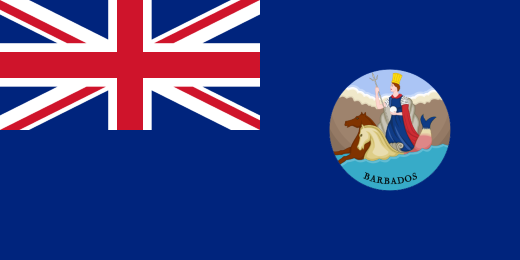
Colonial flag of Barbados (1885–1962)
The island used a British Blue Ensign with the colonial badge. The badge showed Britannia holding a trident.
Sodacan, CC BY-SA 4.0, via Wikimedia Commons.
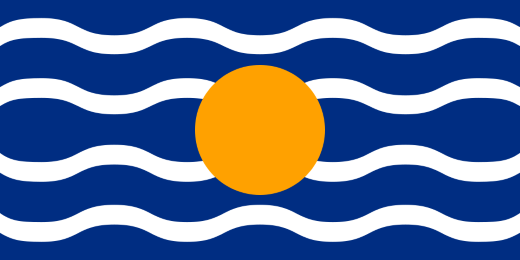
Flag of the West Indies Federation (1958–1962)
From 1958 to 1962, Barbados was part of the West Indies Federation. The federation used a blue flag featuring four wavy white lines representing the sea and a golden sun in the center.
History of Barbados’ flag
British colonial period
After some time as a British colony, Barbados became part of the British Windward Islands in 1833, with the Union Jack serving as its official flag.
In 1885, Barbados was re-established as a separate colony. During this period, the island used a British Blue Ensign defaced with the colonial seal.
The seal showed Britannia holding a trident, a symbol that later influenced the design of the modern national flag.
West Indies Federation
From 1958 to 1962, Barbados was part of the West Indies Federation, a short-lived political union of British Caribbean territories. During this period, the federation used a blue flag featuring four wavy white lines and a golden sun.
After the federation was dissolved in 1962, Barbados returned to direct British administration and once again used the colonial Blue Ensign.
Creation of the national flag
In preparation for independence, the government of Barbados organized a nationwide competition to design a new national flag. More than 1,000 designs were submitted.
The winning design was created by Grantley W. Prescod, an art teacher. His design featured three vertical stripes of blue, gold, and blue with a black trident head in the center.
Adoption of the flag
Barbados became an independent nation on 30 November 1966. At midnight on that day, the new national flag was officially adopted.
The flag was raised for the first time by Lieutenant Hartley Dottin of the Barbados Regiment during the independence ceremony.
Symbolism of the trident
The black trident head displayed in the center of the flag was inspired by the trident held by Britannia in Barbados’s colonial emblem.
However, the trident on the national flag is broken, symbolizing Barbados’s break from colonial rule and the beginning of independence.
The three points of the trident also represent the democratic ideals of government of the people, by the people, and for the people.

Caitriona Maria is an education writer and owner of The Facts Institute. With seven years of teaching experience and a background in educational content, she specialises in creating clear reference resources about countries, geography and global topics.