A brief overview of the meaning, history, and key facts about the national flag of Antigua and Barbuda.

Flag of Antigua and Barbuda
The national flag of Antigua and Barbuda features a unique design with a black background, a rising golden sun, and a V-shaped pattern of blue and white set on a red field. The golden sun with seven rays symbolizes the dawn of a new era for the nation. The colors of the flag also carry symbolic meaning: red represents the energy and dynamism of the people as well as the lifeblood of their ancestors, blue symbolizes hope, and black represents the soil and African heritage of the population. The blue, white, and gold colors together represent the country’s natural beauty, interpreted as the sun, sea, and sand. The V-shape stands for “Victory at last!”
Printable Antigua and Barbuda Flag (PNG Download)
Interesting facts about Antigua and Barbuda’s flag
1. The flag of Antigua and Barbuda was designed by Sir Reginald Samuel, an art teacher at an Antiguan high school.
2. The design was selected through a national competition in 1966, which received more than 600 entries.
3. Reginald Samuel reportedly created his winning design in about half an hour and submitted it shortly before the competition deadline.
4. The V-shaped design formed by the red triangles represents victory.
5. The flag was officially adopted in February 1967, when Antigua became a self-governing state in association with the United Kingdom.
Explore more about Antigua and Barbuda:
Facts about Antigua and Barbuda
Evolution of Antigua and Barbuda’s flag
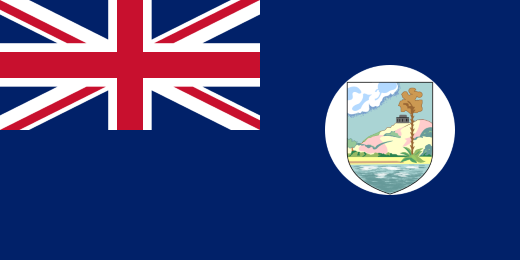
Colonial flags (1956–1967)
Before the adoption of the current national flag, Antigua used a British Blue Ensign with the territory’s coat of arms displayed on the fly.
FOX 52, CC BY-SA 4.0, via Wikimedia Commons.
History of Antigua and Barbuda’s flag
Colonial period
From the early 17th century, Antigua was a British colony, and the islands used British colonial flags for many centuries.
In the 20th century, the territory used a British Blue Ensign with a local coat of arms, a common design used by many British colonies.
Creation of the national flag
In 1966, a public competition was held to design a new national flag in preparation for Antigua becoming a self-governing state.
More than 600 designs were submitted, and the winning design was created by Reginald Samuel, an Antiguan artist and teacher.
Adoption of the flag
The new national flag was officially adopted on 27 February 1967, when Antigua became a self-governing associated state of the United Kingdom.
When the country gained full independence on 1 November 1981, the same flag was retained as the national flag of the independent state of Antigua and Barbuda.

Caitriona Maria is an education writer and owner of The Facts Institute. With seven years of teaching experience and a background in educational content, she specialises in creating clear reference resources about countries, geography and global topics.