A brief overview of the meaning, history, and key facts about the national flag of the Dominican Republic.

Flag of the Dominican Republic
The national flag of the Dominican Republic features a white cross that extends to the edges of the flag, dividing it into four rectangles of blue and red. In the center of the cross is the national coat of arms. The blue rectangles represent the sky and the protection of God over the nation, while the red rectangles symbolize the blood shed by patriots in the struggle for independence. The white cross represents peace and unity among the Dominican people.
Printable Dominican Republic Flag (PNG Download)
Interesting facts about the Dominican Republic flag
1. The flag of the Dominican Republic was designed by Juan Pablo Duarte, one of the country’s founding fathers.
2. Duarte described the design of the flag in the oath of the Trinitarios, a secret society that worked to achieve independence from Haitian rule.
3. The first Dominican flag was sewn by several women, including María Trinidad Sánchez, María de Jesús Pina, Isabel Sosa, and Concepción Bona.
4. The flag was first raised on 27 February 1844, the day the Dominican Republic declared its independence.
5. The Dominican Republic is the only country whose national flag features a Bible inside the coat of arms displayed in the center.
Explore more about the Dominican Republic:
Facts about the Dominican Republic
Evolution of the Dominican Republic flag
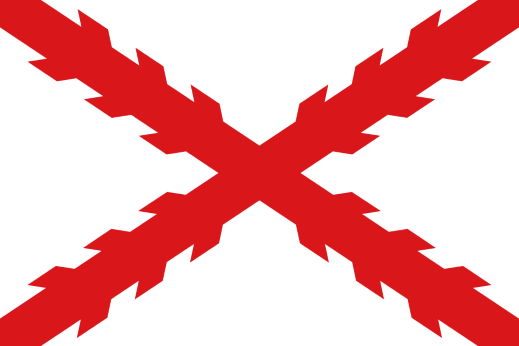
Flag of the Captaincy General of Santo Domingo (1492–1795)
The Dominican Republic used flags associated with the Spanish Empire, including the Cross of Burgundy, a red diagonal cross on a white field.
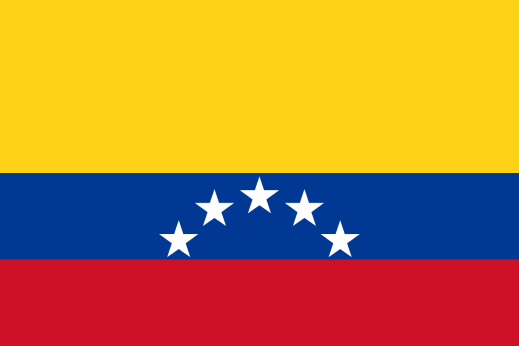
Flag of the Republic of Spanish Haiti (1821–1822)
In 1821, the eastern part of the island briefly declared independence from Spain as the Republic of Spanish Haiti.
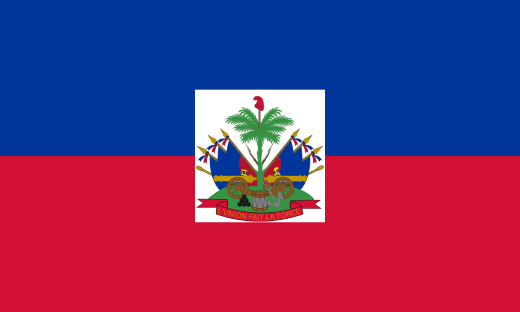
Flag of Haiti (1822–1844)
The entire island of Hispaniola was unified under Haitian rule, and the Haitian flag was used across the territory.
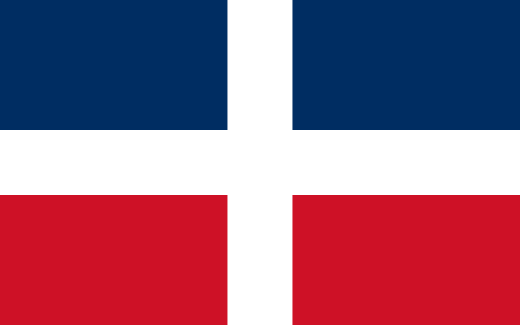
Flag of La Trinitaria (1844)
The revolutionary organization La Trinitaria used a flag featuring a white cross dividing red and blue fields.
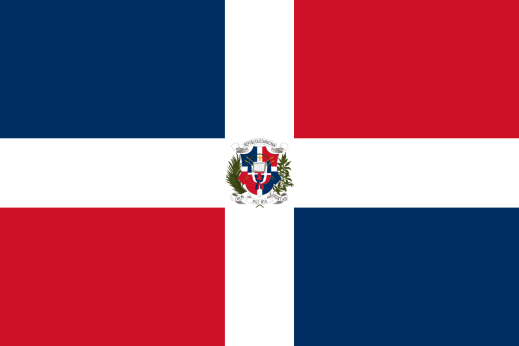
Flag of the Dominican Republic (1849–1861)
The Dominican Republic adopted a version of the flag that included the national coat of arms placed at the center of the white cross.
History of the Dominican Republic flag
Colonial period on Hispaniola
The island of Hispaniola, where the Dominican Republic is located, was first reached by Christopher Columbus in 1492 during his first voyage to the Americas.
Spain soon established settlements on the island, including the colony of Santo Domingo, which became one of the earliest European colonial centers in the New World.
Over time the island was divided between two colonial powers. Spain controlled the eastern portion of the island, while France established the colony of Saint-Domingue in the western part.
Haitian rule over the island
In 1804, the Haitian Revolution led to the creation of Haiti, the first independent nation in Latin America.
Later, in 1822, Haiti occupied the eastern part of Hispaniola and unified the entire island under Haitian control.
Creation of the independence movement
Opposition to Haitian rule led to the creation of a secret revolutionary organization called La Trinitaria in 1838. The group was founded by Juan Pablo Duarte, who became one of the leading figures of the Dominican independence movement.
Duarte described the design of the flag in the oath of the Trinitarios, a secret society founded in 1838 that worked to establish an independent Dominican state.
First use of the flag
The first Dominican flags were sewn by María Trinidad Sánchez, María de Jesús Pina, Isabel Sosa, and Concepción Bona.
The flag was raised for the first time on 27 February 1844, the day the Dominican Republic declared its independence.
Adoption in the constitution
Later in November 1844, the country’s first constitution formally adopted the flag as a national symbol.
At this time the arrangement of the red and blue quarters was adjusted to create the alternating pattern seen on the modern flag.
In 1849, the national coat of arms was added to the center of the white cross, creating the design used on the Dominican flag today.
Later changes
During the Spanish annexation of the Dominican Republic (1861–1865), the Spanish flag temporarily replaced the Dominican flag.
After independence was restored in 1865, the Dominican flag was reintroduced.
The coat of arms includes a Bible opened to John 8:31–32, making the Dominican Republic the only country whose national flag displays a Bible.

Caitriona Maria is an education writer and owner of The Facts Institute. With seven years of teaching experience and a background in educational content, she specialises in creating clear reference resources about countries, geography and global topics.