A brief overview of the meaning, history, and key facts about the national flag of Grenada.

Flag of Grenada
The national flag of Grenada features a bold design with a red border, yellow triangles at the top and bottom and green triangles at the hoist and fly, and a central red disk containing a gold star. Red represents courage, vitality, and the spirit of the people, while green symbolizes the island’s fertile land and agriculture. Gold represents wisdom, warmth, and the sunshine of the island. The seven gold stars stand for the country’s seven parishes, and the nutmeg symbol highlights Grenada’s global reputation as the “Isle of Spice.”
Printable Grenada Flag (PNG Download)
Interesting facts about Grenada’s flag
1. The flag of Grenada was designed by Anthony C. George, a native of Soubise in the parish of St. Andrew.
2. It was officially adopted on 7 February 1974, the day Grenada gained independence from the United Kingdom.
3. The central yellow star set on a red disc represents the Borough of St. George’s, where Grenada’s capital city is located.
4. The six stars on the red border represent the remaining parishes, St. Andrew, St. David, St. John, St. Mark, St. Patrick, and the Grenadines.
Explore more about Grenada:
Evolution of Grenada’s flag
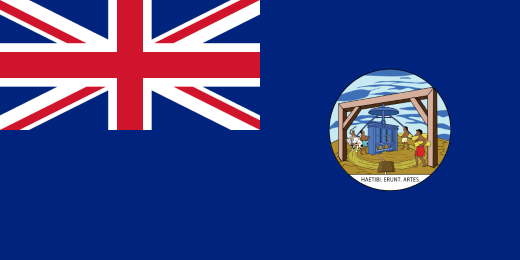
Colonial flag (1875–1903)
During British colonial rule, Grenada used a British Blue Ensign with the territory’s first colonial badge displayed on the fly. This badge depicted a scene representing the island.
Tcfc2349, CC BY-SA 4.0, via Wikimedia Commons.
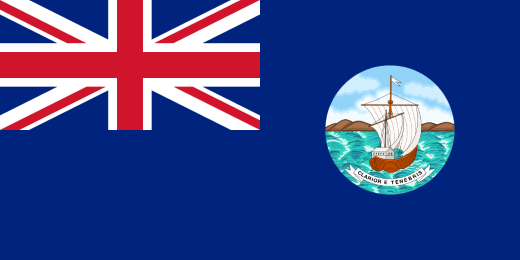
Colonial flag (1903–1967)
In 1903 the colony adopted a revised version of the Blue Ensign with a new colonial badge.
Sodacan, CC BY-SA 4.0, via Wikimedia Commons.
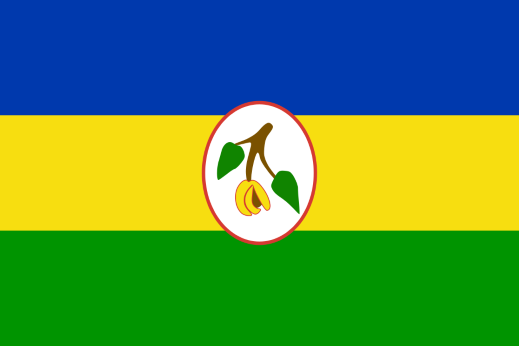
Associated State flag (1967–1974)
When Grenada became an Associated State of the United Kingdom, the new flag featured three horizontal stripes of blue, yellow, and green, with a sprig of nutmeg inside a white oval at the center.
History of Grenada’s flag
Colonial period
Control of Grenada shifted between France and the United Kingdom during the 18th century. This rivalry ended in 1783, when France permanently ceded the island to Britain under the Peace of Paris.
Grenada later became a British crown colony in 1877 and used colonial versions of the British Blue Ensign as its official flag.
Associated State flag
Grenada joined the West Indies Federation in 1958, remaining part of the union until it dissolved in 1962.
On 3 March 1967, Grenada became an Associated State of the United Kingdom, gaining control over internal affairs while Britain retained responsibility for foreign relations and defense.
A new territorial flag was introduced for this period. It consisted of horizontal blue, yellow, and green stripes with a nutmeg symbol in the center.
The design served as a temporary national emblem while the country moved toward independence.
Creation of the national flag
Following political developments that supported independence, a national flag design competition was organized.
The winning design was created by Anthony C. George, an artist from Soubise in Saint Andrew Parish. His design retained the nutmeg symbol from the previous flag.
Adoption of the current flag
The new flag was raised at midnight on 7 February 1974, marking the moment Grenada became an independent country.
The design has remained the official national flag ever since.

Caitriona Maria is an education writer and owner of The Facts Institute. With seven years of teaching experience and a background in educational content, she specialises in creating clear reference resources about countries, geography and global topics.