Botswana has a predominantly semi-arid climate in Southern Africa, with hot summers, cool dry winters and a strongly seasonal pattern of rainfall. The north and east generally receive more rain, while conditions become increasingly dry toward the southwest.
Botswana’s climate at a glance
Warmest average month
January
26.5°C
(79.7°F)
Coolest average month

July
15.0°C
(59.0°F)
Wettest month nationally
January
97.4 mm
(3.83 in)
Driest months nationally

Jul & Aug
0.5 mm
(0.02 in)
Main rainy period

November–April
Main dry
period

May–October
Temperature and precipitation figures are from CRU-CY v4.10, Climatic Research Unit, University of East Anglia. National averages for 1991–2020.
What is the climate of Botswana?
Botswana is dry for much of the year, with most rainfall concentrated into the summer months.
Rainfall generally decreases from north and east toward southwestern Botswana. Annual rainfall can reach around 650 mm in the north but fall below 250 mm in the extreme southwest.
Much of southern and western Botswana forms part of the Kalahari Desert, contributing to the country’s generally dry landscape. The north is somewhat wetter and includes the Okavango Delta, although much of the water responsible for the Delta’s seasonal flooding originates farther north in Angola rather than from rainfall within Botswana itself.
Botswana’s temperatures also change noticeably through the year. Summers are hot, while winter days are generally mild and sunny but nights can become very cold. Temperatures can fall below freezing in some areas, particularly in the southwest, and frost can occur during winter.
Climate types in Botswana
This map shows the main climate types found across Botswana. Each color represents a different climate type, based mainly on long-term patterns of temperature and rainfall.
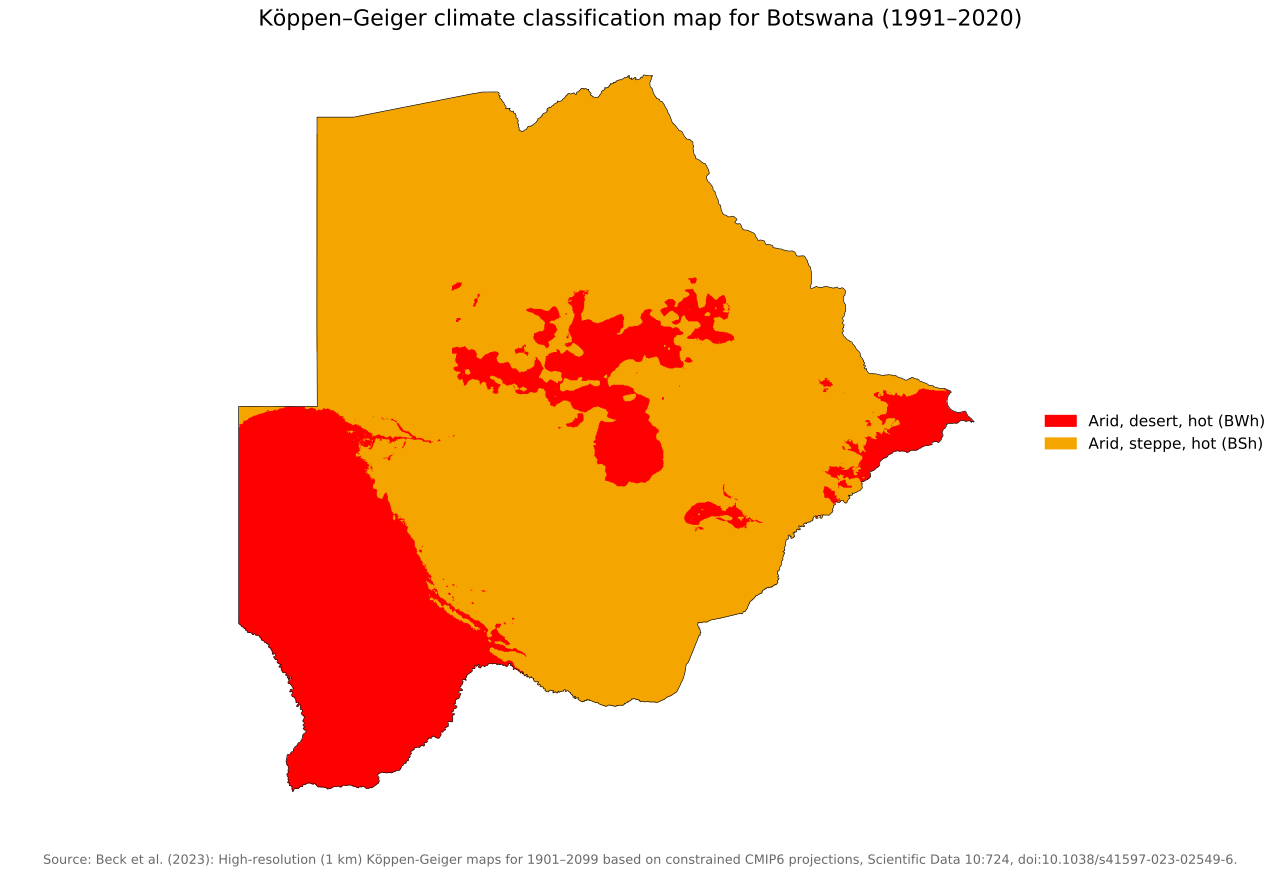
Most of Botswana has a hot semi-arid climate, which covers the majority of the country, including much of the north, east and central areas. The capital, Gaborone, in southeastern Botswana, also has this climate type.
A hot desert climate covers a large part of the southwest and also appears in several smaller areas across the central and eastern parts of the country.
Temperatures in Botswana
Botswana experiences a pronounced seasonal temperature cycle, with hot summers and considerably cooler winters.
Data for 1991–2020 show national average temperatures ranging from about 15.0°C (59.0°F) in July to 26.5°C (79.7°F) in January. Average daytime maximum temperatures remain above 30°C (86°F) from September through March, reaching around 33.5°C (92.3°F) in November.
Winter nights are much cooler. Average minimum temperatures fall from around 20.0°C (68.0°F) in January to only 5.5°C (41.9°F) in July.
| Month | Avg. minimum | Avg. temperature | Avg. maximum |
|---|---|---|---|
| January | 20.0 °C (68.0 °F) | 26.5 °C (79.7 °F) | 32.9 °C (91.2 °F) |
| February | 19.6 °C (67.3 °F) | 25.9 °C (78.6 °F) | 32.3 °C (90.1 °F) |
| March | 18.1 °C (64.6 °F) | 24.8 °C (76.6 °F) | 31.6 °C (88.9 °F) |
| April | 14.7 °C (58.5 °F) | 22.1 °C (71.8 °F) | 29.5 °C (85.1 °F) |
| May | 9.6 °C (49.3 °F) | 18.4 °C (65.1 °F) | 27.3 °C (81.1 °F) |
| June | 6.2 °C (43.2 °F) | 15.4 °C (59.7 °F) | 24.6 °C (76.3 °F) |
| July | 5.5 °C (41.9 °F) | 15.0 °C (59.0 °F) | 24.5 °C (76.1 °F) |
| August | 8.4 °C (47.1 °F) | 18.0 °C (64.4 °F) | 27.6 °C (81.7 °F) |
| September | 12.8 °C (55.0 °F) | 22.1 °C (71.8 °F) | 31.4 °C (88.5 °F) |
| October | 17.1 °C (62.8 °F) | 25.2 °C (77.4 °F) | 33.3 °C (91.9 °F) |
| November | 18.8 °C (65.8 °F) | 26.1 °C (79.0 °F) | 33.5 °C (92.3 °F) |
| December | 19.5 °C (67.1 °F) | 26.4 °C (79.5 °F) | 33.3 °C (91.9 °F) |
These are countrywide averages, and some locations can become colder. At Gaborone airport, for example, historical climate normals show an average July minimum of about 4.4°C (39.9°F).
Rainfall in Botswana
Botswana receives relatively little rainfall overall, and precipitation is highly seasonal.
Data for 1991–2020 show rainfall increasing rapidly toward the end of the year. January is the wettest month nationally, averaging 97.4 mm (3.83 in), followed by February at 78.2 mm (3.08 in).
Most of Botswana’s rainfall occurs during the warmer months, generally from November to April.
| Month | Precipitation |
|---|---|
| January | 97.4 mm (3.83 in) |
| February | 78.2 mm (3.08 in) |
| March | 57.1 mm (2.25 in) |
| April | 26.1 mm (1.03 in) |
| May | 5.6 mm (0.22 in) |
| June | 1.3 mm (0.05 in) |
| July | 0.5 mm (0.02 in) |
| August | 0.5 mm (0.02 in) |
| September | 4.2 mm (0.17 in) |
| October | 18.4 mm (0.72 in) |
| November | 47.9 mm (1.89 in) |
| December | 69.7 mm (2.74 in) |
Rainfall then decreases sharply through autumn. July and August are the driest months in the national dataset, each averaging only 0.5 mm (0.02 in).
These national averages also hide a strong geographical pattern. Northern and eastern Botswana are generally wetter, while rainfall becomes increasingly scarce toward the southwest. Northern areas can receive around 650 mm (26 in) annually, compared with less than 250 mm (10 in) in the extreme southwest in the Kgalagadi district.
How is Botswana’s climate changing?
Botswana has experienced substantial warming in recent decades. Since the 1970s, average mean surface temperature has increased by around 1.5°C (2.7°F), with some parts of the country warming even more.
Temperatures are expected to continue rising. Climate projections indicate that Botswana could be around 2°C to 2.5°C (3.6–4.5°F) warmer by 2050, alongside more frequent and severe heatwaves.
Rainfall is more difficult to project, but Botswana is expected to face increasing pressure from drought and longer dry periods. Changes in rainfall could also differ geographically, with some northeastern areas potentially experiencing more precipitation than other parts of the country.
Reference
Harris I, Osborn TJ, Jones P and Lister D (2020) Version 4 of the CRU TS Monthly High-Resolution Gridded Multivariate Climate Dataset. Sci Data 7, 109. https://doi.org/10.1038/s41597-020-0453-3.

Caitriona Maria is an education writer and owner of The Facts Institute. With seven years of teaching experience and a background in educational content, she specialises in creating clear reference resources about countries, geography and global topics.