Home to a gargantuan desert, an unparalleled array of wildlife and ancient rock art, these are the most interesting facts about Botswana.

Official name: Republic of Botswana
Capital city: Gaborone
Population: 2.6 million
Area: 581,730 sq km
Major languages: Setswana, Sekalanga, Shekgalagadi, English
Major religions: Christianity, traditional beliefs (such as Badimo)
Time zone: UTC+2 / Central Africa Time
Fun facts about Botswana
1. Botswana has been continuously inhabited by Khoisan (Khoe and San) speaking people for at least 18,000 years from around 17,000 BC to about 1650 AD.
2. However, a recent study suggests that the ancestral home of modern humans may have been in Botswana. According to DNA samples, scientists believe that Homo sapiens lived 200,000 years ago in an oasis south of the Zambezi River in modern-day Botswana.

3. Until 2004, Botswana had the world’s highest rate of HIV-Aids infection. Today, it has one of Africa’s most advanced treatment programmes and medicine for the virus is readily available.
4. Botswana is the world’s second-largest producer of diamonds after Russia and Africa’s largest.
5. Many of the biggest diamonds on Earth have originated from Botswana. The second-largest rough diamond ever discovered at 2,492-carat was unearthed in Botswana in 2024. In 2021, a 1,174.76-carat and a 1,098-carat diamond were discovered within a week of each other in the same mine.

6. Botswana is the longest continuous multi-party democracy in Africa.
7. From 1885, Botswana was a British protectorate known as Bechuanaland. In 1966 it gained full independence from the UK.
8. Sir Seretse Khama was Botswana’s first president serving from 1966 to 1980. In 1951, he was forced into exile by Britain after marrying an English woman, Ruth Williams. When he returned, he negotiated the terms of Botswana’s independence.

9. The enormous Kalahari Desert stretches over a huge part of Botswana. It covers up to 70% of the country’s land area.
10. As such, Botswana is an extremely arid country and has often suffered from droughts. Its currency is called ‘pula’ which means ‘rain’ in Setswana.
11. It was once thought that Botswana was part of the only four-nation quadripoint (the point where four territories meet) on the planet. However, GPS has now confirmed the countries of Botswana, Namibia, Zambia and Zimbabwe do not all meet at one point. Instead, the area features a unique ‘double tripoint’ where two tripoints are separated by around 150m: Namibia, Botswana, and Zambia in one site and Zambia, Zimbabwe, and Botswana in another.
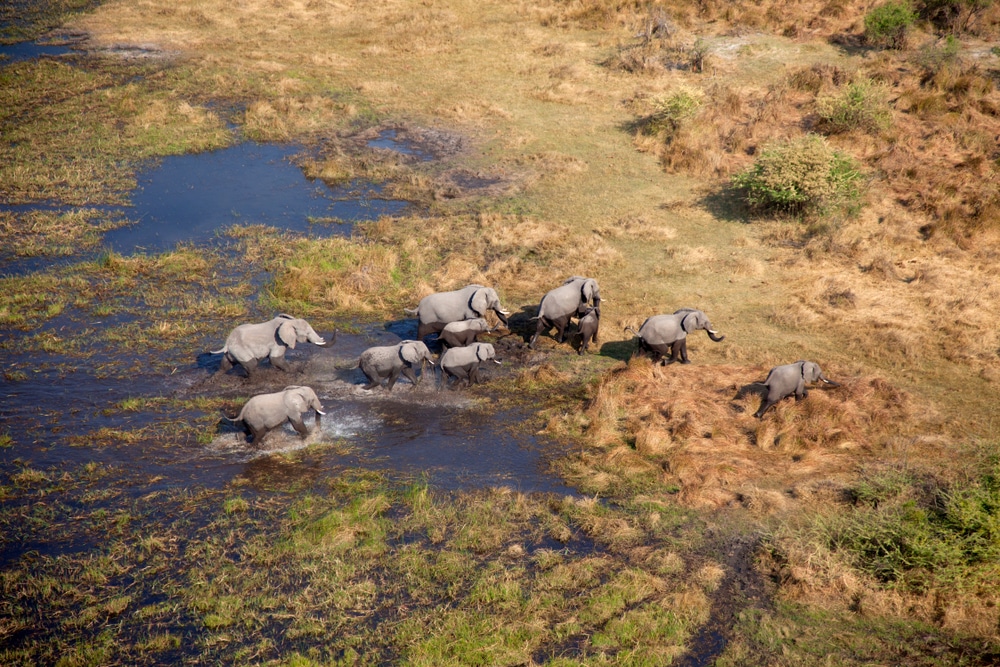
12. Botswana has the world’s largest population of elephants, numbering over 130,000. The Okavango Delta plays a core role in the species’ survival.
13. The Okavango Delta is one of the world’s few major inland deltas that does not flow into a sea or ocean. Its annual flood is fed by rain that fell months earlier in Angola, arriving in Botswana during the dry season. This unusual pattern is one of the most distinctive features of Botswana’s climate.
14. Botswana is landlocked by Namibia, Zambia, Zimbabwe, and South Africa. A landlocked country has no direct access to the sea. There are currently 45 such countries and five partially recognized states.

15. Botswana is a sparsely populated country. While it is smaller than France in land area, it has just 2.45 million people compared to France’s 68.3 million. Botswana has around 4 people per square kilometer, compared to 124 in France.
16. Around a third of Botswana’s landmass is officially protected either by national parks and game reserves or “wildlife management areas”.
17. Unlike many African flags that use red, yellow, and green pan-African colors, Botswana adopted a distinctive light blue, black, and white design. The pattern of white and black was inspired by the coat of the zebra.

18. Bechuanaland had no distinctive national symbols of its own prior to independence. Instead, the flag’s black stripe and white bordering stripes represent a belief in racial cooperation and equality. The light blue background is associated with the sky and water.
19. Botswana is among Africa’s safest and most stable nations, showing no measurable impact from terrorism in recent years.
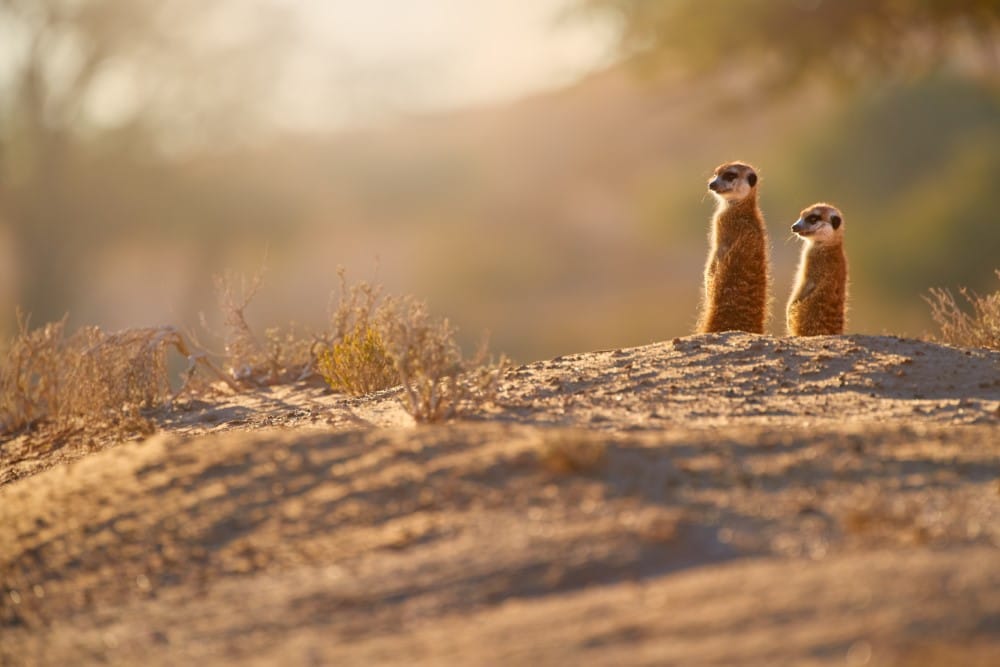
20. Botswana is home to a wide variety of wildlife. It is possible to observe the famous big five game animals in Botswana: lion, leopard, rhino, elephant and buffalo.
21. There is also a huge variety of other animals including between 160 and 500 distinct mammal species, at least 593 bird species, 150 unlike reptiles, more than 8,000 insect and spider species, and more than 3,100 types of plants and trees.
22. The body of a man known as ‘El Negro’ rests in Botswana. Having died in 1831 (probably in modern-day South Africa), the man’s body was dug up, stuffed, and then heinously displayed in European museums. In 2000, following a campaign, the man’s remains were reburied in Botswana.
23. There are over 4,500 rock paintings preserved in an area of Botswana known as the “Louvre of the Desert”. The area also has evidence of human activity going back at least 100,000 years.
24. Taylor Swift’s music video for her song Wildest Dreams was filmed in Botswana. The video later drew criticism from some viewers, who felt it romanticized colonial-era Africa.
25. Mopane worms, which are actually caterpillars, are a delicacy in Botswana. The insects are rich in protein and calcium and are often stirred into stews of tomatoes and peanuts.
26. Chobe National Park was Botswana’s first national park and is considered one of Africa’s great wildlife destinations. It has a huge population of elephants, several species of predators, and over 560 recorded bird species.
27. Botswana has one of the largest salt pans in the world. Botswana’s Makgadikgadi Pans are the salty remains of an ancient inland sea that may once have covered up to 275,000 sq km (about the size of New Zealand). For much of the year, they are dry salt flats, but the rainy season briefly turns them into wetlands that attract zebras, wildebeest and flamingos.
Explore more: Test your knowledge with our Africa map quiz.
We strive to verify all facts using authoritative and primary sources where possible. However, if you find an error or have any questions, please contact us.

Caitriona Maria is an education writer and owner of The Facts Institute. With seven years of teaching experience and a background in educational content, she specialises in creating clear reference resources about countries, geography and global topics.