A brief overview of the meaning, history, and key facts about the national flag of Angola.
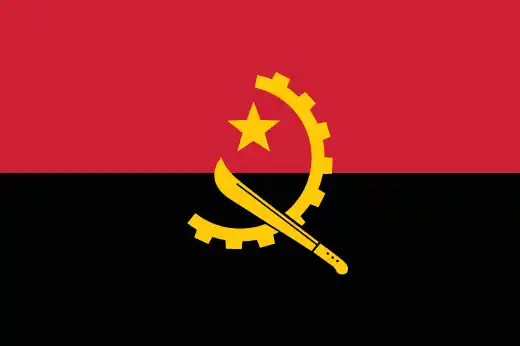
Flag of Angola
The national flag of Angola consists of two horizontal stripes: red on top and black on the bottom. The red stripe represents the blood shed by Angolans during colonial oppression, the struggle for national liberation, and the defense of the country. The black stripe symbolizes the African continent. At the center of the flag is a yellow emblem made up of a cogwheel, a machete and a star. The cogwheel represents workers and industrial production, the machete symbolizes farmers, agricultural production, and the armed struggle, and the star represents international solidarity and progress. The yellow color of these symbols represents the country’s wealth.
Printable Angola Flag (PNG Download)
Interesting facts about Angola’s flag
1. The national flag of Angola was adopted on 11 November 1975, the same day the country proclaimed independence from Portugal.
2. The design of Angola’s flag is based on the flag of the People’s Movement for the Liberation of Angola (MPLA), the movement that led the independence struggle.
3. Vexillologists have noted that the half gear, machete, and star resemble the hammer and sickle symbol used on flags of the former Soviet Union.
4. Although the symbols originally reflected the ideology of the independence movement, their meanings are now generally interpreted more broadly to represent Angola.
5. In 2003, Angola considered adopting a completely new national flag after the end of the civil war, but the proposal was ultimately rejected.
Explore more about Angola:
Evolution of Angola’s flag
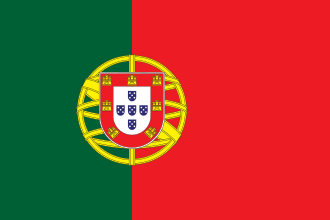
Flag of Portugal (colonial period–1975)
During the Portuguese colonial period, Angola used the national flag of Portugal as its official flag.
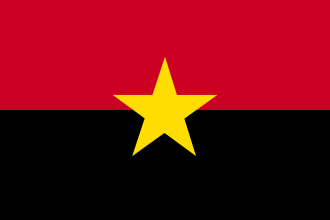
Flag of the People’s Movement for the Liberation of Angola (MPLA)
The flag of the MPLA consists of two horizontal stripes: red above black, with a yellow star at the center.
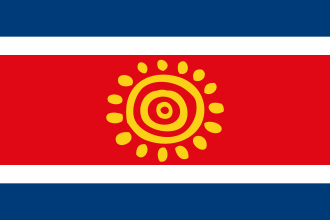
Proposed flag of Angola (2003)
In 2003, Angola considered adopting a new national flag but it was never officially adopted. The design featured three horizontal stripes of blue, white, and red with a yellow sun symbol at the center.
History of Angola’s flag
Colonial period
During the Portuguese colonial period, Angola used the flag of Portugal.
Independence and adoption of the national flag
The Angolan War of Independence ended after the Carnation Revolution in Portugal in 1974, which led to the beginning of decolonization.
On 10 November 1975, the Portuguese flag was lowered in the capital of Luanda. Authority was transferred to the Angolan people, and at midnight the following day the People’s Republic of Angola was proclaimed.
During the independence ceremony on 11 November 1975, a new national flag based on the MPLA flag was raised.
Rival movements during independence
Although the MPLA proclaimed independence in Luanda, other independence movements also controlled parts of the country.
The National Union for the Total Independence of Angola (UNITA) declared a rival government on the same day and continued to use its own flag in the territories it controlled during the Angolan Civil War between 1975 and 2002.
Debate over changing the flag
Following the end of the civil war in 2002, Angola’s National Assembly considered introducing new national symbols as part of the country’s post-war political reforms. A constitutional commission reviewed proposals for a new flag design.
A public competition selected a design submitted under the pseudonym “Catica.” The proposal included blue, white, and red stripes and a central yellow sun symbol. The sun was based on ancient rock paintings from the Tchitundu-Hulu historical site in Namibe Province.
Despite winning the competition, the design was never adopted due to public debate and concerns that changing the flag would remove the historical symbolism associated with Angola’s independence struggle.

Caitriona Maria is an education writer and owner of The Facts Institute. With seven years of teaching experience and a background in educational content, she specialises in creating clear reference resources about countries, geography and global topics.