A brief overview of the meaning, history, and key facts about the national flag of Guinea-Bissau.
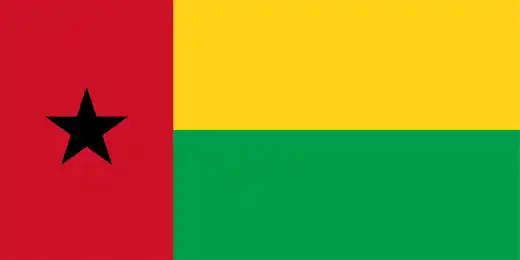
Flag of Guinea-Bissau
The national flag of Guinea-Bissau consists of a red vertical stripe at the hoist featuring a black five-pointed star, alongside two horizontal stripes on the fly side: yellow on top and green on the bottom. The black star symbolizes African unity. The yellow stripe represents the sun, the green stripe symbolizes hope, and the red stripe represents the blood shed during the long struggle for independence.
Printable Guinea-Bissau Flag (PNG Download)
Interesting facts about Guinea-Bissau’s flag
1. Guinea-Bissau adopted its national flag on 24 September 1973, the same day the country proclaimed its independence from Portugal.
2. The design of the flag is almost identical to the flag of the African Party for the Independence of Guinea and Cape Verde (PAIGC), the movement that led the struggle for independence.
3. The flag of Guinea-Bissau is closely related to the flag once used by Cabo Verde because both countries fought for independence under the PAIGC, which originally intended to unite the two nations.
4. At the time, the black star on the PAIGC flag symbolized anti-colonial resistance, while the red bar was also said to represent the country’s location on the West African coast.
5. The colors red, yellow, and green are part of the pan-African color tradition, which was popularized by countries such as Ghana and Guinea.
Explore more about Guinea-Bissau:
Evolution of Guinea-Bissau’s flag
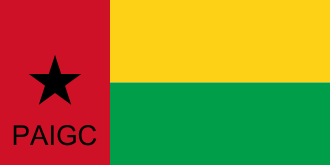
Flag of the African Party for the Independence of Guinea and Cape Verde (1961–1973)
Before independence, the African Party for the Independence of Guinea and Cape Verde (PAIGC) adopted a flag in 1961 using the Pan-African colors red, yellow, and green along with a black star. The design also included the initials PAIGC beneath the star.
History of Guinea-Bissau’s flag
Independence and adoption of the flag
Guinea-Bissau proclaimed independence from Portugal on 24 September 1973. The declaration was made by a National Assembly appointed by the PAIGC, the political movement that had led the struggle against Portuguese rule.
On the same day, the assembly adopted the national flag.
Constitutional description of the flag
The first constitution of Guinea-Bissau described the national flag as consisting of three bands with equal surface area. One band is red and arranged vertically with a black star, while the other two are arranged horizontally with yellow on top and green below.
The constitution also established the national motto “Unity, Struggle, Progress.”
Origins of the design
The design of Guinea-Bissau’s flag originates from the flag of the PAIGC, which had adopted a similar design in 1961. This was inspired by the pan-African colors used by existing flags of neighboring countries.

Caitriona Maria is an education writer and owner of The Facts Institute. With seven years of teaching experience and a background in educational content, she specialises in creating clear reference resources about countries, geography and global topics.