A brief overview of the meaning, history, and key facts about the national flag of São Tomé and Príncipe.
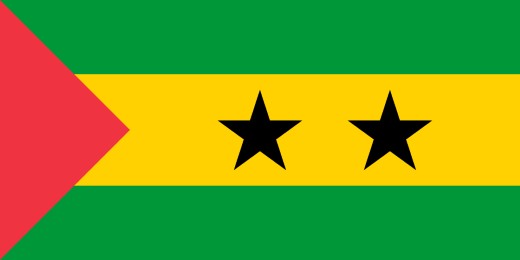
Flag of São Tomé and Príncipe
The national flag of São Tomé and Príncipe consists of three horizontal stripes: green at the top and bottom and a wider yellow stripe in the center. A red triangle extends from the hoist side, and two black five-pointed stars appear on the yellow band. Green represents the islands’ rich vegetation, yellow symbolizes the tropical sun and the country’s cocoa production, and red represents the struggle for independence and equality. The two black stars represent the two main islands of the nation: São Tomé and Príncipe.
Printable São Tomé and Príncipe Flag (PNG Download)
Interesting facts about São Tomé and Príncipe’s flag
1. The flag was officially adopted on 12 July 1975, the day the country became independent from Portugal.
2. The design is based on the flag of the Movement for the Liberation of São Tomé and Príncipe (MLSTP), the political movement that led the country to independence.
3. The flag was designed by Manuel Pinto da Costa, who became the first president of São Tomé and Príncipe.
4. The flag uses the pan-African colors of green, yellow, and red, which appear on many African national flags.
Explore more about São Tomé and Príncipe:
Facts about São Tomé and Príncipe
Evolution of São Tomé and Príncipe’s flag
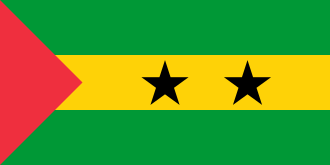
Flag of the Movement for the Liberation of São Tomé and Príncipe (1972–1975)
Before independence, the Movement for the Liberation of São Tomé and Príncipe (MLSTP) used a flag with an almost identical design as the current national flag. However, its three horizontal stripes were of equal width.
History of São Tomé and Príncipe’s flag
Colonial period
The islands of São Tomé and Príncipe were colonized by Portugal in the late 15th century, and Portuguese rule continued for several centuries.
During the colonial period, Portuguese symbols and flags were used to represent the territory.
Independence movement
Nationalist sentiment increased during the mid-20th century, particularly after events such as the Batepá massacre in 1953, which strengthened calls for independence.
The MLSTP was founded in 1960 and became the main organization leading the struggle for independence.
Adoption of the national flag
In 1974, several designs for a national flag were proposed, all incorporating the pan-African colors.
A modified version of the MLSTP flag, designed by Manuel Pinto da Costa, was ultimately selected. The flag was officially adopted on 12 July 1975, when São Tomé and Príncipe became an independent country.
The design has remained unchanged since its adoption.

Caitriona Maria is an education writer and owner of The Facts Institute. With seven years of teaching experience and a background in educational content, she specialises in creating clear reference resources about countries, geography and global topics.