A brief overview of the meaning, history, and key facts about the national flag of Ireland.

Flag of Ireland
Adopted by the Irish state in 1922, Ireland’s flag features three stripes of green, white and orange. The green stripe represents the Irish nationalist tradition, historically associated with the Catholic majority, while the orange symbolizes the Protestant tradition. The white stripe signifies peace and unity between the two communities.
Printable Ireland Flag (PNG Download)
Interesting facts about Ireland’s flag
1. The Irish tricolor was first presented in 1848 to Thomas Francis Meagher by a group of French women sympathetic to Irish nationalism. It was inspired by the French tricolor but didn’t become widespread for about 70 years.
2. Before the tricolor became dominant, a green flag with a gold harp had long been used as a symbol of Ireland, particularly from the 17th century onward.
3. During the Easter Rising, the tricolor was raised above the General Post Office in Dublin by Gearóid O’Sullivan, helping to establish it as a national symbol.
4. Early versions of the flag did not always follow today’s standard order. In some early examples, orange appeared next to the flagstaff instead of green.
5. The color orange refers to William of Orange, the Protestant king who defeated James II at the Battle of the Boyne in 1690. His supporters later formed the Orange Order, and the color became associated with the Protestant community in Ireland.
6. Green had long been associated with Ireland before the tricolor was introduced, particularly through the green harp flag and the 18th-century United Irishmen. By the 19th century, it was widely linked with Irish nationalist tradition.
Explore more about Ireland:
Evolution of the Irish flag
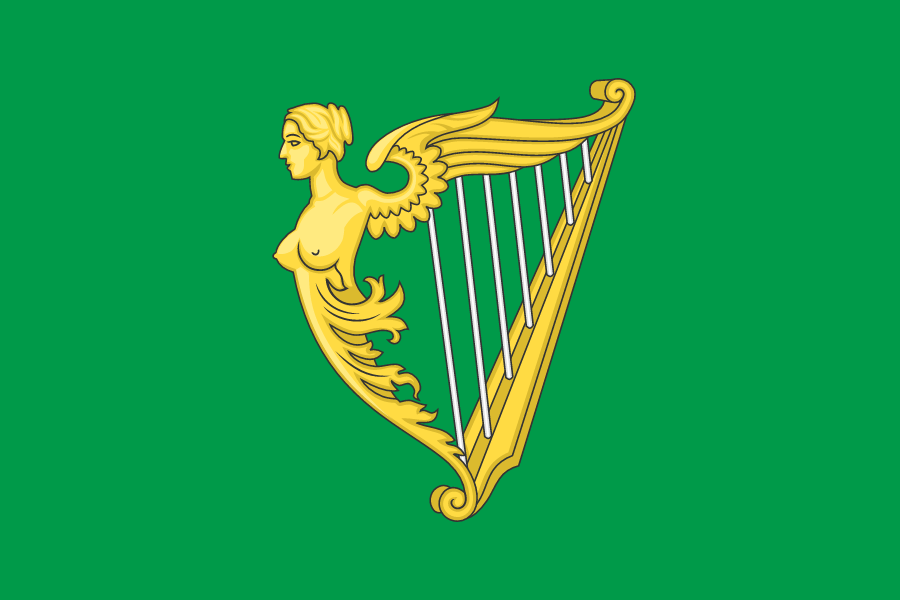
The green harp flag
A green field bearing a gold harp, widely used from the 17th century onward as a national symbol of Ireland and associated with various nationalist movements prior to the adoption of the tricolor.
History of Ireland’s flag
The harp has been associated with Ireland since at least the medieval period and appears in manuscripts and heraldic rolls from the 13th century. By the 17th century, a green flag bearing a gold harp was in use and became widely regarded as a national symbol of Ireland.
In 1642, a green harp flag is recorded as being used by forces led by Eoghan Ruadh Ó Néill. During the 18th century, green became increasingly associated with Irish nationalist movements. The United Irishmen in the 1790s used green flags, often featuring a harp emblem.
Emergence of the tricolor
The earliest recorded use of the colors green, white and orange together as a political emblem dates to 1830, when tricolor cockades were worn at public meetings.
The modern Irish tricolor was first publicly unveiled on 7 March 1848 in Waterford by Thomas Francis Meagher. Inspired by the French tricolor, the design symbolized hoped-for unity between traditions represented by green and orange, with white representing peace between them.
The flag did not gain widespread acceptance at the time and was rarely used between 1848 and the early 20th century. The green harp flag remained more common during this period.
Adoption during the independence period
The tricolor gained prominence during the Easter Rising of 1916 when it was raised above the General Post Office in Dublin. From that point, it became closely associated with the Irish independence movement.
During the Irish War of Independence (1919–1921), the tricolor was used as the flag of the proclaimed Irish Republic.
After the establishment of the Irish Free State in 1922, the new government continued to use the tricolor, although this was not initially specified in legislation.
Constitutional confirmation
In 1937, the Constitution of Ireland formally confirmed the national flag in Article 7, stating: “The national flag is the tricolor of green, white and orange.”
The design has remained unchanged since.

Caitriona Maria is an education writer and owner of The Facts Institute. With seven years of teaching experience and a background in educational content, she specialises in creating clear reference resources about countries, geography and global topics.