A brief overview of the meaning, history, and key facts about the national flag of the Philippines.

Flag of Philippines
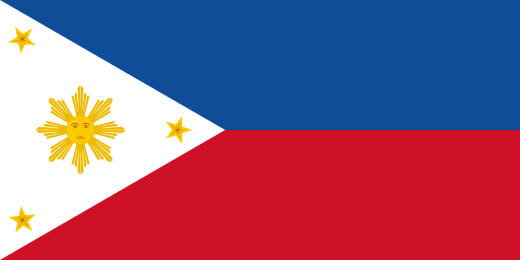
The national flag of the Philippines features a horizontal blue stripe above a red stripe with a white equilateral triangle at the hoist. Inside the triangle is a golden sun with eight rays and three five-pointed stars at each corner. The eight rays represent the first provinces that revolted against Spanish rule, while the three stars symbolize the country’s three main geographic regions: Luzon, Visayas, and Mindanao. The colors also carry symbolic meanings: white represents peace and purity, blue symbolizes the nation’s ideals, and red reflects courage and the willingness to defend the country.
Printable Philippines Flag (PNG Download)
Interesting facts about the Philippines’ flag
1. The Philippine flag was sewn in Hong Kong by Marcela Agoncillo, her daughter Lorenza, and Delfina Herbosa de Natividad, a niece of the national hero José Rizal.
2. The flag was first raised by General Emilio Aguinaldo on 12 June 1898 in Kawit, Cavite, during the declaration of Philippine independence.
3. The eight rays of the sun represent the first eight provinces that revolted against Spanish rule: Batangas, Bulacan, Cavite, Laguna, Manila, Nueva Ecija, Pampanga and Tarlac.
4. The triangular design of the flag is believed to have been influenced by the Katipunan, a revolutionary society that fought for Philippine independence.
5. When the flag is inverted or flown upside down, it signals the nation is in a state of war. In 2010, the US had to apologize for accidentally flying the Philippine flag upside down during a presidential event in New York.
6. In the Philippines, National Flag Day is celebrated on May 28, and the national flag is widely displayed from May 28 to June 12, the country’s Independence Day.
Explore more about the Philippines:
Evolution of the Philippines’ flag
Original revolutionary flag (1898–1907)
The first Philippine national flag featured a white triangle, a golden eight-ray sun with a face and three stars.

Re-adoption of the national flag (1919–1936)
After the ban was lifted, the Philippine flag was once again allowed to be displayed and was officially adopted.
History of the Philippines flag
Creation of the flag
The Philippine national flag was first conceived by Emilio Aguinaldo, the leader of the Philippine Revolution.
It was sewn in Hong Kong by Marcela Agoncillo, her daughter Lorenza, and Delfina Herbosa de Natividad, a niece of national hero José Rizal.
The flag was first displayed in battle on May 28, 1898, during the Battle of Alapan in Cavite.
Declaration of independence
The flag was formally unfurled during the Philippine Declaration of Independence on June 12, 1898, at Aguinaldo’s residence in Kawit, Cavite.
The design included a sun with a face similar to the Sun of May, and with eight rays representing the first provinces that revolted against Spanish rule.
American colonial period
After the United States took control of the Philippines, the display of the Philippine flag was prohibited under the Flag Act of 1907.
The law was repealed in 1919, allowing the flag to be displayed again.
Standardization of the flag
In 1936, President Manuel L. Quezon issued Executive Order No. 23, which established the official proportions and design specifications of the Philippine flag.
These standards remain largely unchanged today.
World War II
During the Japanese occupation of the Philippines in World War II, the display of the Philippine flag was again restricted. It was later raised in 1943 during the establishment of the Second Republic of the Philippines.
During wartime, the Philippine flag is flown with the red stripe above the blue, a unique feature that signals that the country is in a state of war. After the liberation of the Philippines in 1945, the flag continued to be used until the country gained independence from the United States in 1946.

Caitriona Maria is an education writer and owner of The Facts Institute. With seven years of teaching experience and a background in educational content, she specialises in creating clear reference resources about countries, geography and global topics.