A brief overview of the meaning, history, and key facts about the national flag of Puerto Rico.
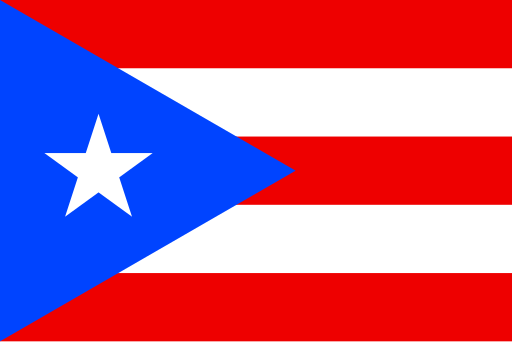
Flag of Puerto Rico
Officially recognized in 1952, Puerto Rico’s flag features five horizontal stripes in alternating red and white. On the hoist side, an equilateral triangle bears a centered white star. The three red stripes and three corners of the triangle symbolize the three branches of government, while the white stripes stand for liberty and human rights. The triangle’s medium-blue color represents the sky and ocean, and the star represents the commonwealth.
Printable Puerto Rico Flag (PNG Download)
Key facts about Puerto Rico’s flag
1. The Puerto Rican flag was chosen in exile in New York City in 1895 by members of the Cuban Revolutionary Party and was created by reversing the red and blue colors of the Cuban flag.
2. The flag is popularly known as Monoestrellada (Monostarred), meaning having only one star.
3. There are two historical claims regarding the design of the Puerto Rican flag, with Antonio Vélez Alvarado and Manuel de Besosa both cited as possible designers.
4. Between 1948 and 1957, Puerto Rico’s “Gag Law” made it illegal to display the Puerto Rican flag, along with other nationalist symbols.
5. The Puerto Rican government identified the triangle as “medium blue” in a 1995 regulation, but no specific color codes were defined. As a result, minor shade variations can be seen in different reproductions of the flag.
6. A lighter blue version is often associated with the original 1895 design and has been used by some supporters of Puerto Rican independence.
Explore more about Puerto Rico:
Evolution of the Puerto Rico flag
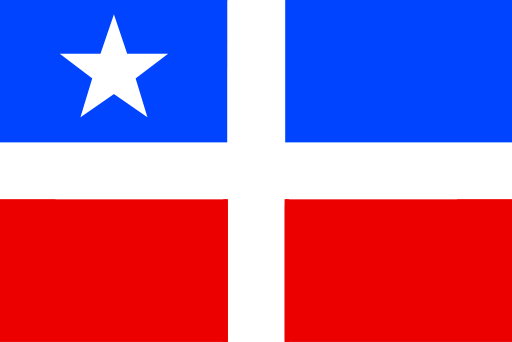
Grito de Lares flag (1868)
Used during the 1868 uprising against Spanish rule, this flag features a white cross dividing red and blue quarters, with a white star in the upper hoist-side quadrant. It is recognized as the first Puerto Rican revolutionary flag.
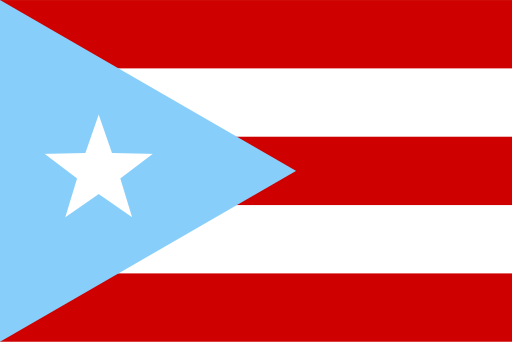
Puerto Rican flag (1895)
Adopted in exile in New York City in 1895, this design reversed the red and blue colors of the Cuban flag. The triangle originally appeared in a lighter shade of blue.

Puerto Rican flag (1952)
After Puerto Rico became a commonwealth in 1952, a darker shade of blue became widely used in official reproductions of the flag.
History of Puerto Rico’s flag
Spanish period
Christopher Columbus landed on the island in 1493 and claimed it for the Spanish Crown. During Spanish rule, the royal standard of Castile and later the Cross of Burgundy were flown on the island, reflecting its status as part of the Spanish Empire.
The Grito de Lares (1868)
In 1868, during the Grito de Lares uprising against Spanish rule, revolutionaries used a flag featuring a white cross dividing red and blue quarters with a white star. Although short-lived, this design is recognized as the first Puerto Rican revolutionary flag and reflected growing nationalist sentiment.
The modern design (1895)
The current design of the Puerto Rican flag was adopted in exile in New York City on December 22, 1895, by the Puerto Rican section of the Cuban Revolutionary Party. The design reversed the red and blue colors of the Cuban flag, symbolizing solidarity between the two independence movements.
There are differing historical accounts regarding the exact designer of the flag, with Antonio Vélez Alvarado and Manuel de Besosa both cited in historical sources.
Early 20th century and official recognition
Following the Spanish-American War in 1898, Puerto Rico came under United States administration. The flag was at times treated as a symbol of political dissent.
On July 25, 1952, when Puerto Rico officially became a commonwealth associated with the United States, the flag received official recognition.
Color clarification (1995)
In 1995, the Puerto Rican government issued a regulation identifying the triangle as “medium blue,” although no exact color codes were specified.

Caitriona Maria is an education writer and owner of The Facts Institute. With seven years of teaching experience and a background in educational content, she specialises in creating clear reference resources about countries, geography and global topics.