A brief overview of the meaning, history, and key facts about the national flag of the Republic of Congo.
It should not be confused with the flag of the Democratic Republic of the Congo.

Flag of the Republic of Congo
The national flag of the Republic of the Congo consists of a diagonal tricolor of green, yellow, and red. A yellow diagonal band runs from the lower hoist to the upper fly, dividing the flag into a green upper triangle and a red lower triangle. Green represents the country’s forests and agriculture, yellow symbolizes the friendship and nobility of the Congolese people, and red commemorates the bloodshed during the struggle for independence.
Printable Republic of Congo Flag (PNG Download)
Interesting facts about the Republic of Congo’s flag
1. The national flag of the Republic of the Congo was first approved on 18 August 1959 and officially adopted on 15 September 1959, shortly before the country gained independence from France in 1960.
2. The flag uses the pan-African colors of green, yellow, and red, which are widely associated with African independence movements.
3. From 1970 to 1991, the Republic of the Congo used a different national flag during its period as a socialist state.
Explore more about the Republic of Congo:
Facts about the Republic of Congo
Evolution of Republic of Congo’s flag
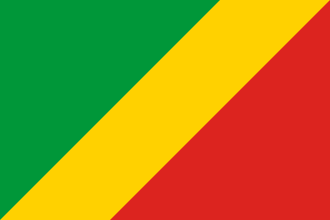
National flag of the Republic of the Congo (1959–1970)
The flag featured a diagonal design of green, yellow, and red, the same design used by the current national flag.
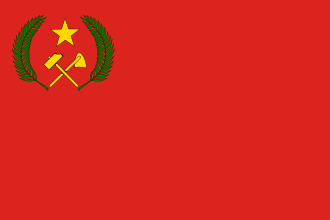
Flag of the People’s Republic of the Congo (1970–1991)
After the establishment of a Marxist one-party state, the country adopted a new national flag. The design consisted of a red field with a socialist emblem in the canton.
History of the Republic of Congo’s flag
Colonial background
The territory that is now the Republic of the Congo came under French control in the late nineteenth century after treaties were signed between French explorer Pierre Savorgnan de Brazza and local rulers.
The region later became part of French Equatorial Africa, a federation of French colonies that existed from 1910 to 1958.
Creation of the national flag
Following a French constitutional referendum in 1958, the federation of French Equatorial Africa was dissolved and several territories became autonomous republics within the French Community.
The territory known as Moyen-Congo was renamed the Republic of the Congo, and a new national flag was introduced in 1959.
Independence and early use
The Republic of the Congo gained full independence from France on 15 August 1960. The national flag adopted in 1959 remained in use after independence.
Socialist period
In 1969, a Marxist government established a one-party state known as the People’s Republic of the Congo. A new national flag featuring socialist symbols replaced the original flag.
Restoration of the original flag
Political reforms in 1991 led to the restoration of multiparty democracy. During this transition, the government reinstated the original green, yellow, and red flag that had been introduced in 1959.

Caitriona Maria is an education writer and owner of The Facts Institute. With seven years of teaching experience and a background in educational content, she specialises in creating clear reference resources about countries, geography and global topics.