A brief overview of the meaning, history, and key facts about the national flag of Uzbekistan.
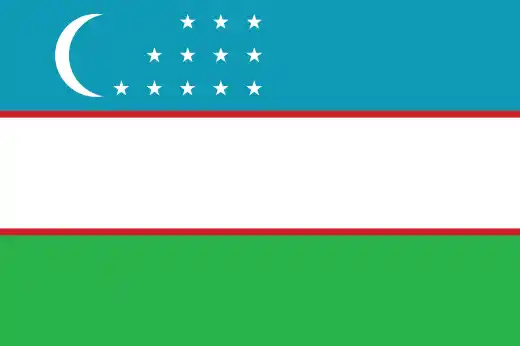
Flag of Uzbekistan
Approved in 1991, the national flag of Uzbekistan consists of three horizontal stripes of blue, white, and green, separated by thin red lines. In the upper hoist corner a white new half moon and twelve stars appear. The blue stripe represents the sky and water and also symbolizes historical continuity, as blue was used in the flag of Amir Temur’s state. The white stripe represents peace and goodwill, and the green stripe represents nature, new life, and abundance.
Printable Uzbekistan Flag (PNG Download)
Interesting facts about Uzbekistan’s flag
1. The national flag of Uzbekistan was officially approved on 18 November 1991, shortly after the country became independent.
2. The white stripe symbolizes peace in Uzbek culture, reflected in the Uzbek expression “ok yul!”, meaning “go in peace.”
3. The two thin red lines symbolize vital energy or “the power of life.”
4. The new half moon on the flag represents both the newly independent republic and the historical traditions of the Uzbek people.
5. The twelve stars symbolize the twelve regions of Uzbekistan and the ancient solar calendar.
6. Some interpretations also link the twelve stars to the historical development of astrology in the region. In this view, the stars reflect the ancient cultural traditions of the area and symbolize the Uzbek people’s aspirations toward perfection and loyalty.
7. Uzbekistan’s flag is unusual because the exact shades of the colors are not strictly defined in law. This is why you may see slight variations between flags.
Explore more about Uzbekistan:
Evolution of Uzbekistan’s flag
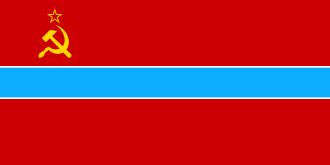
Flag of the Uzbek Soviet Socialist Republic (1952–1991)
During the Soviet period, Uzbekistan used a flag based on the design of the Soviet Union. The flag featured a red field with the hammer and sickle and star in the canton, along with a horizontal blue stripe separated by thin white lines.
History of Uzbekistan’s flag
Soviet period
Before independence, Uzbekistan was part of the Soviet Union as the Uzbek Soviet Socialist Republic.
Early Soviet-era flags of the republic consisted of a red field displaying abbreviations of the republic’s name in Uzbek, Russian, and for a time Tajik.
In 1952, a new flag design was introduced that more closely followed the style used by many Soviet republics. The flag featured a red field with the hammer and sickle and star, along with a horizontal blue stripe bordered by thin white lines.
Independence and new national symbols
Uzbekistan declared independence on 1 September 1991, shortly before the dissolution of the Soviet Union. Following independence, the government organized a competition to design a new national flag.
More than 200 design proposals were submitted and evaluated by a special commission formed to review the entries.
Adoption of the national flag
The winning design was officially adopted on 18 November 1991 during an extraordinary session of the Uzbek Supreme Soviet.
With this decision, Uzbekistan became the first of the newly independent Central Asian republics to adopt a new national flag, replacing the Soviet-era banner with a design reflecting the country’s history, culture, and independence.

Caitriona Maria is an education writer and owner of The Facts Institute. With seven years of teaching experience and a background in educational content, she specialises in creating clear reference resources about countries, geography and global topics.