The most interesting facts about Equatorial Guinea, from one of the world’s wettest places to a corrupt dictator with a playboy son.
Fast facts
Official name: Republic of Equatorial Guinea
Capital city: Ciudad de la Paz
Population: 1.9 million
Area: 28,051 sq km
Major languages: Spanish, Fang, Bubi, Portuguese, French, Creoles
Major religions: Christianity, Islam and traditional Indigenous beliefs
Time zone: UTC+1 (West Africa Time)
Interesting facts about Equatorial Guinea
1. Equatorial Guinea is a country located in West Africa, bordering Cameroon and Gabon.
2. Equatorial Guinea consists of Río Muni on continental Africa (also known as Continental Equatorial Guinea) and five islands (known collectively as insular Equatorial Guinea).
3. Equatorial Guinea was first sighted by a European in 1472 when Portuguese navigator Fernao do Po spotted the island of Fernando Po, which is now called Bioko.

4. Portugal initially colonized the islands of Annobon and Bioko before ceding them and parts of the mainland to Spain in exchange for regions in Latin America. As such, Bioko became an important base for the slave trade.
5. The Spanish settled in Río Muni on mainland Equatorial Guinea in 1844, then renamed the colony the Western African Territories in 1904 before renaming it Spanish Guinea.
6. The flag of Equatorial Guinea is made up of horizontal stripes of green, white, and red, with a blue triangle on the left and the national coat of arms in the center. The blue stands for the sea, while green stands for vegetation, white for peace, and red for the bloodshed during the liberation struggle.

See how Equatorial Guinea’s flag compares to other African flags.
7. The coat of arms includes a silk-cotton tree (also known as the god tree), the motto of the country in Spanish– “Unity, peace, justice” – and six golden stars for the five main islands and the coastal territory.
8. After striking oil in 1995, Equatorial Guinea has become Africa’s eighth biggest oil producer. Crude oil and petroleum gas exports account for over 75% of Equatorial Guinea’s total exports in 2022.
9. Equatorial Guinea is Africa’s third-least populous mainland country.
10. Equatorial Guinea has one of the world’s lowest life expectancies at just 64 years.
11. Ciudad de la Paz on the mainland is now the official capital of Equatorial Guinea, replacing Malabo as of 2026.

12. The previous capital city, Malabo, is not on the mainland. It sits on Bioko Island, about 160 km (100 mi) from continental Equatorial Guinea.
13. Despite the name’s prevalence, it is unclear where the name Guinea originates. Some trace it to a word in Tuareg, aginaw. Others think it once referred to Djenné, a trading city in Mali. In the 15th century, Portuguese sailors used “Guiné” to describe what is now Senegal, and by the 18th century, Europeans used “Guinea” to refer to much of West Africa.
14. Malabo is named after Malabo Lopelo Melaka (1837–1937), the last king of the Bubi, the ethnic group indigenous to the island of Bioko.
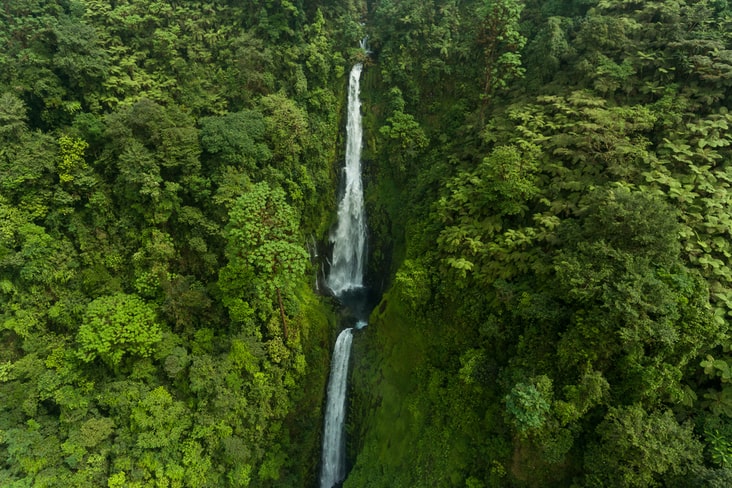
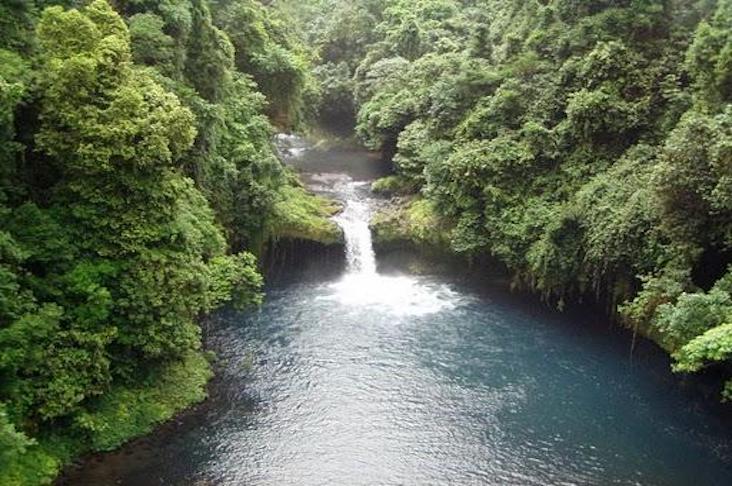
15. The tiny village of Ureca in Equatorial Guinea is the wettest place in Africa and one of the wettest in the world, receiving up to 450 inches (11,430 mm) of rain per year.
16. Equatorial Guinea is named for the Guinea region of West Africa, which lies along the Gulf of Guinea and stretches north to the Sahel. The “equatorial” part refers to the country’s position just north of the Equator.
17. There are four countries in the world with the word Guinea in their name: Equatorial Guinea, Guinea and Guinea-Bissau in Africa, and Papua New Guinea in Oceania.
18. Equatorial Guinea is sub-Sahara Africa’s third-richest country when measured by GDP per capita based on purchasing power parity (PPP).
19. The world’s largest frogs are only found in Equatorial Guinea and Cameroon. Goliath frogs (Conraua goliath) can grow up to 34cm long and weigh over 3.2kg.

20. Equatorial Guinea is the only sovereign African country where Spanish is an official language.
21. Teodoro Obiang Nguema Mbasogo has been president since 1979 after seizing power from his uncle in a coup. He is currently Africa’s longest-serving head of state and the world’s longest-serving president.
22. Mr. Obiang Nguema has been described by rights organizations as a brutal dictator. Rights organizations have frequently accused the government of corruption and human rights abuses despite the country’s oil wealth.
23. His son, Teodorín Nguema Obiang, has also faced international corruption investigations over luxury assets including private jets, sports cars, and Michael Jackson memorabilia.

24. Equatorial Guinea is one of 27 countries that doesn’t have any UNESCO World Heritage Sites. It also doesn’t have any properties on the Tentative List that are intended to be submitted for nomination.
25. The Monte Alen National Park in Equatorial Guinea is a protected area covering 2,000 sq km where it’s possible to see gorillas, chimpanzees, elephants and crocodiles as well as many different species of birds and insects.
26. At around 94%, Equatorial Guinea has the second-highest literacy rate of any sub-Saharan African country. Only Seychelles has a higher rate (96%).
Explore more: Test your knowledge with our Africa map quiz.
We strive to verify all facts using authoritative and primary sources where possible. However, if you find an error or have any questions, please contact us.

Caitriona Maria is an education writer and owner of The Facts Institute. With seven years of teaching experience and a background in educational content, she specialises in creating clear reference resources about countries, geography and global topics.