The most interesting facts about Gabon, from “the land of the surfing hippos” and “Africa’s Last Eden” to 400,000 years of history.

Fast facts
Official name: Gabonese Republic
Capital city: Libreville
Population: 2.6 million
Area: 267,667 sq km
Major languages: French and Bantu languages
Major religions: Christianity, Islam
Time zone: UTC+1 (West Africa Time)
Interesting facts about Gabon
1. Gabon is located on the west coast of Africa and is bordered by Equatorial Guinea, Cameroon and the Republic of Congo.
2. Archaeological evidence suggests Gabon has been inhabited for over 400,000 years from the Palaeolithic, through the Neolithic and Iron Age, to the present day Bantu and Pygmy peoples.
3. The name Gabon comes from the Portuguese word “gabao” meaning “cloak”. Early explorers thought the estuary of the Komo River by the capital of Libreville was the shape of a cloak.

4. Gabon’s first contact with Europeans began with the arrival of the Portuguese in 1472. The British, Dutch and French all followed and trafficked slaves as well as ivory and tropical wood.
5. Libreville, the capital city, was originally settled by freed slaves in 1849. Libreville means “free town” in French which imitates Freetown, the capital of Sierra Leone.
6. Gabon has a horizontally striped green, yellow and blue flag. The yellow represents the Equator, the green symbolizes the extensive forested area, and the blue reflects the sea.
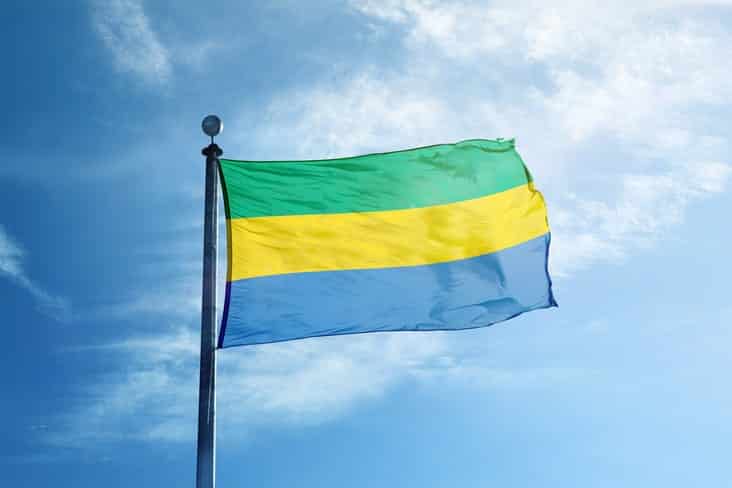
See how Gabon’s flag compares to other African flags.
7. Gabon was a French colony from 1839 and then part of French Equatorial Africa from 1910.
8. Gabon is one of 13 countries that the Equator passes through. Traditionally, countries closer to the equator tend to struggle more economically due to the drawbacks caused by a hot climate which is often more unstable than more moderate-climate nations.
9. However, Gabon is one of the region’s more stable countries and is considered to be a “high” level of human development in the latest Human Development Index (HDI), albeit the lowest-ranked of the subcategory.

10. Over one-tenth of Gabon’s territory is protected by national parkland.
11. Loango National Park in Gabon is known as “Africa’s Last Eden” and is considered one of the world’s best wildlife-watching destinations with animals such as elephants, gorillas, crocodiles and sitatunga antelopes found on its savannahs, lagoons and beaches.

12. Gabon has two UNESCO World Heritage Site, the Ecosystem and Relict Cultural Landscape of Lopé-Okanda and Ivindo National Park. These sites contain a mix of well-conserved tropical rainforest and relict savannah landscapes which are home to a wide diversity of species, including endangered large mammals, and habitats.
13. The site features Lopé National Park has some of the highest concentration of elephants ever recorded with an estimated three per square kilometre.
14. Lopé National Park is also home to the biggest troupes of mandrill in the world.

15. The site is also home to 1,800 petroglyphs (rock carvings) as well as well-preserved remains of habitation around hilltops, caves and shelters from the Stone and Iron Ages. Together, they demonstrate 400,000 years of almost continuous history.
16. The Ebola virus wiped out 90% of western lowland gorillas in Gabon and the Republic of Congo during outbreaks in the 1990s and 2000s.

17. Having led the country since 1967, Gabon’s second president, Omar Bongo, was Africa’s longest-serving head of state at the time of his death in 2009. Additionally, Bongo was the world’s second-longest-serving non-royal leader after Cuba’s Fidel Castro, at the time of his death.
18. Pygmies, who settled in Gabon during the late Stone Age, are known for their short stature as they typically only grow to 150 cm (4 ft 11 in) high. Today they represent just 0.3% of the population of Gabon.
19. More than 88% of Gabon is covered in rainforest, making it one of the most forested countries in Africa.

20. Gabon is one of Africa’s least densely populated countries, with a population density of around 10 people per square kilometer.
21. Frenchman Albert Schweitzer won the 1952 Nobel Peace Prize for his humanitarian work in Gabon. In 1924, Schweitzer founded a hospital to treat leprosy in Lambaréné in what was then French Equatorial Africa. The hospital is still operational today.
22. Gabon is home to the world’s largest species of sea turtle, the leatherback. Leatherbacks can grow up to 7ft (2.1m) in length and weigh as much as 2,000lbs (900kg).
23. Gabon’s Mayumba National Park is a marine park that sees 550 leatherback turtles – 30% of the world’s total population – lay their eggs there between November and April. The park is also a mating ground for humpback whales and large groups of dolphins, including the rare humpback dolphin.
Explore more: Test your knowledge with our Africa map quiz.
We strive to verify all facts using authoritative and primary sources where possible. However, if you find an error or have any questions, please contact us.

Caitriona Maria is an education writer and owner of The Facts Institute. With seven years of teaching experience and a background in educational content, she specialises in creating clear reference resources about countries, geography and global topics.