A brief overview of the meaning, history, and key facts about the national flag of East Timor (Timor-Leste).
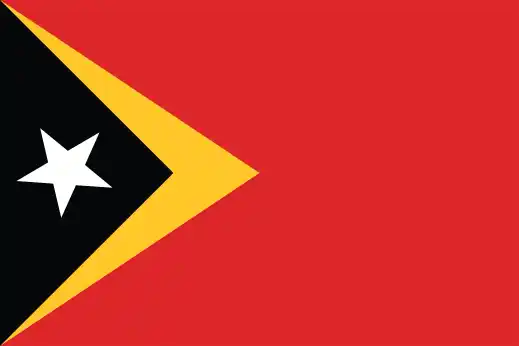
Flag of East Timor
The national flag of East Timor consists of a red field with two overlapping isosceles triangles at the hoist. The larger triangle is yellow and the smaller triangle is black. In the center of the black triangle is a white five-pointed star. The yellow triangle represents the traces of colonialism in East Timor’s history, the black triangle symbolizes the obscurantism that must be overcome, the red field represents the struggle for national liberation, and the white star stands for peace and guidance.
Printable East Timor Flag (PNG Download)
Interesting facts about East Timor’s flag
1. The national flag of East Timor was first adopted on 28 November 1975, when the country declared independence from Portugal.
2. When East Timor restored its independence in 2002, the country reinstated the same national symbols used during the 1975 declaration of independence, including the national flag.
3. During Indonesian rule from 1975 to 1999, the use of the Timorese flag was forbidden and displaying it could lead to severe punishment.
4. When the constitution was finalized in 2002, the symbolism of the colors was clarified. The yellow triangle was officially defined as representing the traces of colonialism, rather than the country’s wealth as previously suggested.
Explore more about East Timor:
History of East Timor’s flag
Portuguese colonial period
For centuries East Timor was a colony of Portugal. During this time the Portuguese national flag was used as the official flag of the territory.
The Portuguese authorities also gave flags to local rulers known as Liurais, which became important sacred symbols in local culture and were seen as a sign of legitimate authority.
Independence and the 1975 flag
After the Carnation Revolution in Portugal in 1974, the country began preparing its colonies for independence. Political parties formed in Portuguese Timor, including the independence movement Fretilin.
On 28 November 1975, East Timor declared independence and adopted a new national flag featuring red, yellow, black, and white elements. However, the independence lasted only a short time.
Indonesian occupation
Just nine days after independence was declared, Indonesia invaded East Timor in December 1975. The Indonesian government banned the Timorese flag and replaced it with the Indonesian national flag.
Despite the ban, the independence flag became an important symbol of resistance for the Timorese people during the occupation.
Restoration of independence
In 1999, a United Nations–supervised referendum allowed the people of East Timor to vote for independence. The territory was placed under UN administration until independence was formally restored.
At midnight on 19 May 2002, the United Nations flag was lowered and the national flag of East Timor was raised, officially restoring the country’s independence.

Caitriona Maria is an education writer and owner of The Facts Institute. With seven years of teaching experience and a background in educational content, she specialises in creating clear reference resources about countries, geography and global topics.