A brief overview of the meaning, history, and key facts about the national flag of Haiti.
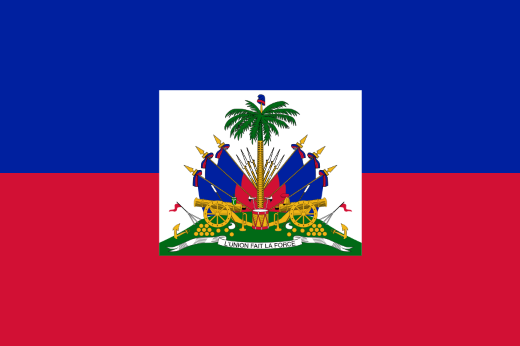
Flag of Haiti
Adopted in 1986, the national flag of Haiti consists of two horizontal stripes of blue and red, with the country’s coat of arms displayed in a white panel at the center. The blue and red colors are traditionally associated with Haiti’s Black and mixed-race populations and were derived from the colors of the French tricolor.
Printable Haiti Flag (PNG Download)
Interesting facts about Haiti’s flag
1. Haiti is one of the few national flags in the world that displays the country’s coat of arms on the flag itself.
2. The coat of arms features a palm tree topped with a Phrygian cap, symbolizing liberty, along with flags, cannons, drums, and other military elements.
3. Beneath the coat of arms appears the national motto: “L’Union Fait La Force” (“Unity Is Strength”).
4. Haiti shares its blue-and-red color scheme with the flag of Liechtenstein. The similarity was discovered at the 1936 Summer Olympics, leading Liechtenstein to add a crown to its flag in 1937.
Explore more about Haiti:
Evolution of Haiti’s flag

Flag of Haiti (1803–1804)
During the Haitian Revolution, revolutionary leaders removed the white stripe from the French tricolor and joined the remaining blue and red sections together.
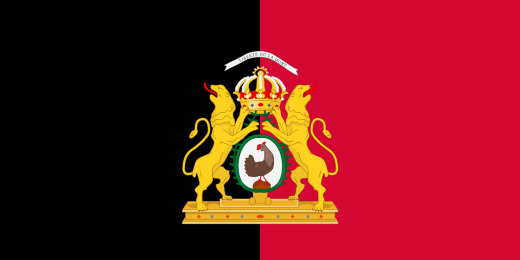
Flag of Haiti (1805–1806)
After declaring himself Emperor Jacques I, Jean-Jacques Dessalines adopted a black-and-red flag with vertical stripes. Black stood for death while red stood for freedom.
Samhanin, CC BY-SA 3.0, via Wikimedia Commons.
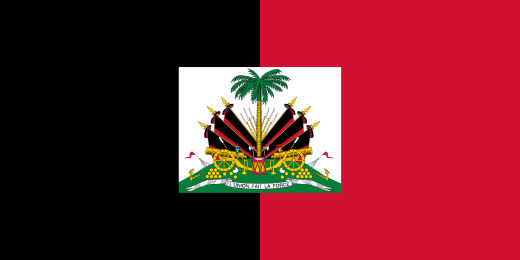
Flag of Haiti (1964–1986)
The government of François Duvalier reintroduced the black-and-red colors, while retaining the national coat of arms.
History of Haiti’s flag
Origins during the Haitian Revolution
The origins of Haiti’s flag date to the Haitian Revolution. In 1803, revolutionary leaders meeting at Arcahaie adopted a new flag by removing the white stripe from the French tricolor and joining the blue and red sections together.
According to Haitian tradition, Catherine Flon sewed the first version of the flag. The blue and red colors came to symbolize the the alliance between Black and mixed-race Haitians during the struggle for independence.
Independence and early changes
Haiti gained independence from France on 1 January 1804. Shortly afterward, the blue-and-red flag was modified so that the stripes were arranged horizontally.
In 1805, Emperor Jean-Jacques Dessalines replaced the flag with a black-and-red design. After his death in 1806, Haiti returned to the blue-and-red colors, and the national coat of arms was eventually added to the center.
The Duvalier era
In 1964, President François Duvalier introduced a new black-and-red version of the national flag. This design remained in use throughout the Duvalier period, a totalitarian hereditary dictatorship that lasted almost 29 years
Restoration of the current flag
Following the fall of Jean-Claude Duvalier’s government in 1986, Haiti restored the traditional blue-and-red flag with the national coat of arms displayed in a white panel at the center.
The design was reaffirmed by the Constitution of 1987 and remains the national flag of Haiti today.

Caitriona Maria is an education writer and owner of The Facts Institute. With seven years of teaching experience and a background in educational content, she specialises in creating clear reference resources about countries, geography and global topics.