A brief overview of the meaning, history, and key facts about the national flag of Central African Republic.

Flag of Central African Republic
The national flag of the Central African Republic consists of four horizontal stripes of blue, white, green, and yellow, with a vertical red stripe running down the center. A yellow star appears in the upper left corner. The blue, white, and red colors reflect the influence of France, the former colonial power. The green, yellow, and red represent the pan-African colors, symbolizing the broader African identity and aspirations for unity. The red vertical stripe represents the shared sacrifices and struggles of the people.
Printable Central African Republic Flag (PNG Download)
Interesting facts about Central African Republic’s flag
1. The flag was introduced on 1 December 1958 by President Barthélémy Boganda when the territory of Oubangui-Chari became the Central African Republic.
2. Boganda designed the flag to combine elements representing both the country’s colonial past and its vision for African unity.
3. The yellow star symbolizes guidance and represents the hope that the people will move toward freedom and progress.
4. Early symbolism linked to the Movement for the Social Evolution of Black Africa (MESAN) included a hand pointing toward a star. While the national flag retains the star, the hand was not included in the final design.
5. Some interpretations connect the colors of the flag to different regions of Central Africa: blue represents the Congo and the ocean, white represents Chad and its cotton, green symbolizes Gabon and its forests, yellow represents the Central African Republic and its mineral wealth, and red represents the blood shed by those who struggled for liberation.
Explore more about Central African Republic:
Facts about Central African Republic
Evolution of Central African Republic’s flag
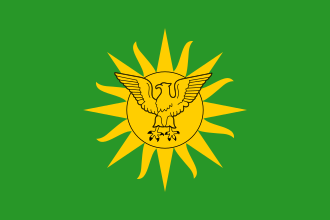
Imperial standard of Bokassa I (1976–1979)
Bokassa proclaimed the Central African Empire and adopted a personal imperial standard. This flag featured a light green field with a golden eagle placed over a twenty-pointed star.
TRAJAN 117, CC BY-SA 3.0, via Wikimedia Commons.
History of Central African Republic’s flag
French Equatorial Africa was a federation that included Gabon, Moyen-Congo (now the Republic of the Congo), Ubangi-Shari and Chad.
During this period there was no separate colonial flag, and the French tricolor was used as the official flag of the territory.
Creation of the national flag
The national flag of the Central African Republic was designed by Barthélémy Boganda, a political leader who later became the country’s prime minister.
The design was first presented to the Legislative Assembly of Ubangi-Shari on 1 December 1958, when the territory became the Central African Republic within the French Community.
Boganda explained that the colors were chosen to represent both the territories of French Equatorial Africa and France, which had been the colonial power.
The vertical red stripe running through the center of the flag symbolizes the blood shared by the people and the sacrifices made in the struggle for freedom and unity.
Symbolism and unity
The design reflects Boganda’s broader vision of unity between African peoples as well as cooperation between Africans and Europeans.
The combination of colors from the French tricolor and the pan-African palette was intended to symbolize both historical ties and the aspiration for a united Africa.
The yellow star in the canton represents independence and hope for the future, symbolizing a guiding light for the nation.
Continued use of the flag
The flag introduced in 1958 has remained the national flag of the Central African Republic without any official changes.
Even during the period when the country briefly became the Central African Empire between 1976 and 1979, the same national flag continued to be used alongside the emperor’s personal standard.

Caitriona Maria is an education writer and owner of The Facts Institute. With seven years of teaching experience and a background in educational content, she specialises in creating clear reference resources about countries, geography and global topics.