A brief overview of the meaning, history, and key facts about the national flag of Nigeria.

Flag of Nigeria
The national flag of Nigeria consists of three vertical stripes: green on the left and right, with a white stripe in the center. The green bands represent the country’s natural wealth and abundant vegetation, while the white band symbolizes unity and peace.
Printable Nigeria Flag (PNG Download)
Interesting facts about Nigeria’s flag
1. The Nigerian flag was designed in 1959 and was officially adopted on 1 October 1960, the same day Nigeria gained independence from Britain.
2. The design of Nigeria’s flag was chosen through a national competition that received almost 3,000 entries. The winning design was created by Michael Taiwo Akinkunmi, a student from Ibadan.
3. Akinkunmi’s original design included a red sun with sixteen rays in the center of the white stripe, but this element was removed before the flag was officially adopted.
Explore more about Nigeria:
Evolution of Nigeria’s flag
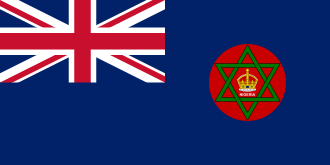
Flag of the Nigerian Protectorate (1914–1960)
Before independence, Nigeria used a colonial flag designed during British rule. It featured a blue field with the Union Jack in the canton and a red disc on the fly side containing a green symbol and crown.
Benchill (original), CC BY-SA 4.0, via Wikimedia Commons.
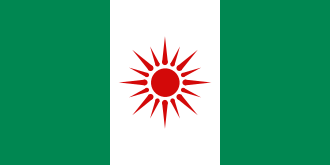
Proposed design by Michael Taiwo Akinkunmi (1959)
The original design submitted by Akinkunmi in the national competition included the same green-white-green vertical stripes used today, but also featured a red sun with sixteen rays in the center.
History of Nigeria’s flag
Design competition before independence
In preparation for independence from Britain, the Nigerian government organized a national competition in 1958 to select a new flag.
Thousands of designs were submitted, and the entry by Michael Taiwo Akinkunmi was selected as the winning design.
Adoption of the national flag
The chosen design consisted of three vertical stripes of green, white, and green. The green stripes represent the country’s agricultural wealth, while the white stripe symbolizes peace and unity.
The flag was officially designed in 1959, but it only became the national flag when Nigeria achieved independence on 1 October 1960.
First raising of the flag
The Nigerian flag was raised for the first time during the independence ceremony by Lieutenant David Ejoor of the Army Guard.

Caitriona Maria is an education writer and owner of The Facts Institute. With seven years of teaching experience and a background in educational content, she specialises in creating clear reference resources about countries, geography and global topics.