There are 49 European countries, though the exact number is often debated.
Geographically, Europe is the second smallest continent, larger only than Australia. It is located entirely in the Northern Hemisphere, bordered by the Arctic Ocean to the north and the Atlantic Ocean to the west.
List of countries in Europe
Here is the alphabetical list of European countries with their capitals. We have also included the countries’ regions, the international standard for country codes (ISO 3166), and continents, as some extend over more than one continent.
Free printables: Download a list of European countries and capitals, including a blank worksheet for practice (PDF).
Do you know the countries of Europe?
Loading activity…
European Union
The 49 countries located on the European continent are not to be confused with the members of the European Union (EU).
The EU is a unique partnership between 27 member states, with a population of approximately 452 million people as of January 2026.
As an EU member, government ministers from each nation come together to discuss laws and coordinate policies. The ministers may commit their own governments to the actions agreed upon in the meetings. Many of these nations share a single currency: the Euro.
Not all European countries are members of the EU. For example, Norway, Switzerland, and the United Kingdom are located in Europe but are not EU members.
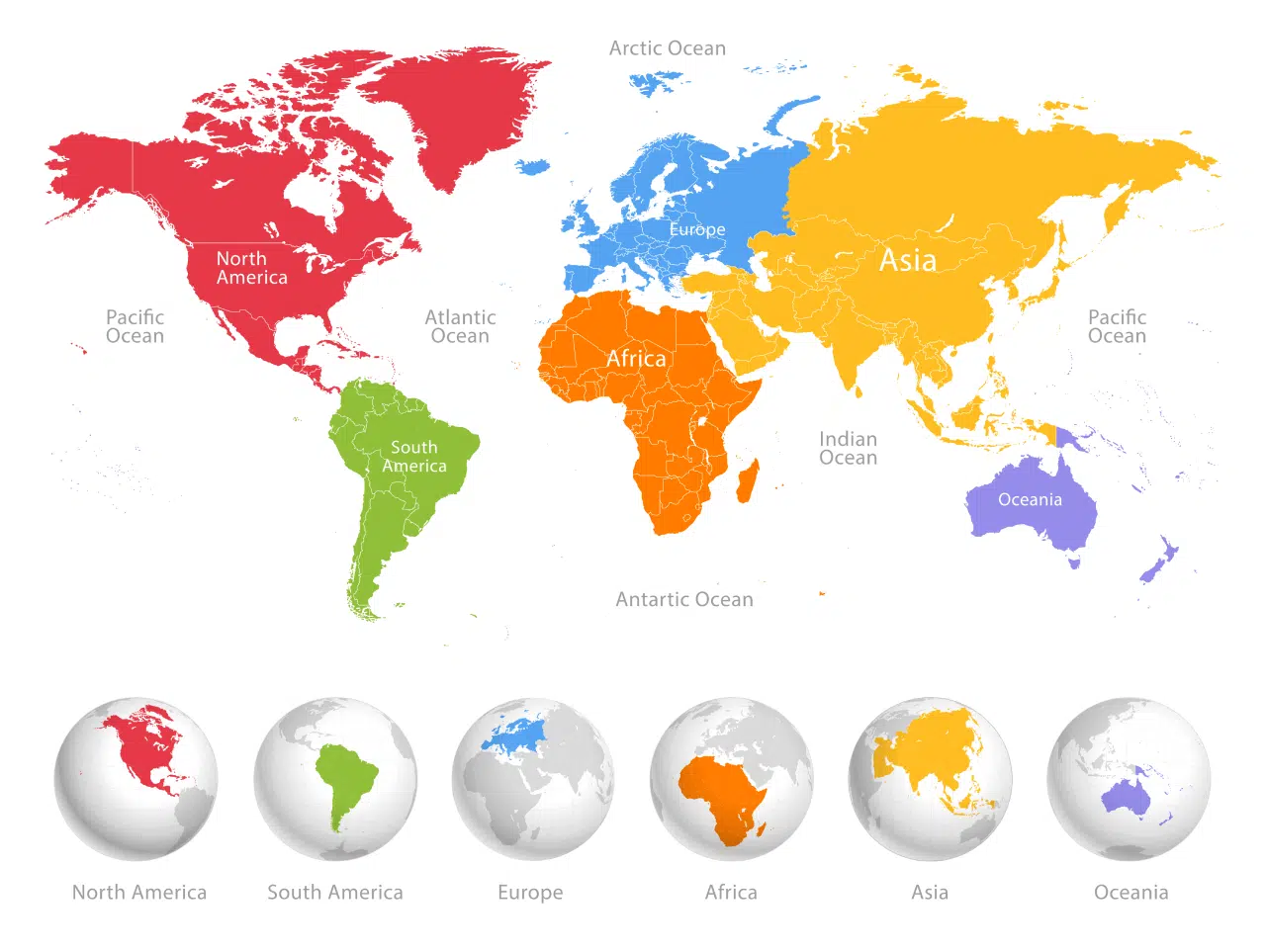
Europe map
Europe is often divided into four regions: Northern Europe, Eastern Europe, Western Europe and Southern Europe.
Our printable European maps show the exact locations of each country.

For continent-wide comparisons beyond the map, see the rankings of European countries by size and by population.
How many countries are in Europe?
There are 49 countries in Europe, according to the Central Intelligence Agency (CIA) World Factbook.
Albania
Andorra
Austria
Azerbaijan
Belarus
Belgium
Bosnia and Herzegovina
Bulgaria
Croatia
Czechia
Denmark
Estonia
Finland
France
Georgia
Germany
Greece
Holy See (Vatican City)
Hungary
Iceland
Ireland
Italy
Kazakhstan
Kosovo
Latvia
Liechtenstein
Lithuania
Luxembourg
Malta
Moldova
Monaco
Montenegro
Netherlands
North Macedonia
Norway
Poland
Portugal
Romania
Russia
San Marino
Serbia
Slovakia
Slovenia
Spain
Sweden
Switzerland
Türkiye
Ukraine
United Kingdom
The CIA Factbook uses a broad definition of Europe that includes several transcontinental states. Transcontinental countries span more than one continent, and these include Azerbaijan, Georgia, Kazakhstan, Russia, and Türkiye.
Georgia is located in the Caucasus region at the boundary between Eastern Europe and Western Asia and is included here following the CIA World Factbook’s regional classification.
Other reports on the number of European countries may include Armenia and Cyprus.
Cyprus is geographically part of Western Asia but is widely regarded as European due to its political alignment and membership in European institutions, including the European Union. Armenia is geographically located in Western Asia and is also considered geopolitically European in some classifications.
If Armenia and Cyprus are included, Europe is sometimes counted as having 51 countries.
Related: How many countries are there in the world?
United Nations members in Europe
Of the 49 European countries listed above, 47 are UN member states. The UN’s regional groups, shown below, use a different classification and do not exactly match this geographical list.
Eastern European states:
- Albania
- Armenia
- Azerbaijan
- Belarus
- Bosnia and Herzegovina
- Bulgaria
- Croatia
- Czechia
- Estonia
- Georgia
- Hungary
- Latvia
- Lithuania
- Montenegro
- North Macedonia
- Poland
- Republic of Moldova
- Romania
- Russian Federation
- Serbia
- Slovakia
- Slovenia
- Ukraine
Western European states or other:
- Andorra
- Austria
- Belgium
- Denmark
- Finland
- France
- Germany
- Greece
- Iceland
- Ireland
- Italy
- Liechtenstein
- Luxembourg
- Malta
- Monaco
- Netherlands
- Norway
- Portugal
- San Marino
- Spain
- Sweden
- Switzerland
- Türkiye* (Turkey)
- United Kingdom of Great Britain and Northern Ireland
The United Nations recognizes Cyprus as a Western Asian state despite becoming a full EU member state in 2004. Kazakhstan is recognized as Central Asian but has close ties with the EU as its biggest trading partner and foreign investor.
Kosovo is not recognized by all UN members, so it cannot be included on this list. The Vatican City (Holy See) is also an independent state in which the Pope of the Catholic Church rules, but it is not a member of the UN.
The Holy See and the State of Palestine were granted permanent observer state status at the UN. As permanent observer states, Palestine and The Holy See have free access to most UN meetings and relevant documentation.

Caitriona Maria is an education writer and owner of The Facts Institute. With seven years of teaching experience and a background in educational content, she specialises in creating clear reference resources about countries, geography and global topics.

Naa-Atswei Mawufemor Lomo is a content writer who contributes educational articles to The Facts Institute. With a background in communication and digital publishing, she specialises in presenting complex information in an accessible and reader-friendly way.