A brief overview of the meaning, history, and key facts about the national flag of Cuba.

Flag of Cuba
Adopted in 1869, the Cuban flag has three navy blue and two white horizontal stripes and a red triangle on the left bearing a white star. The blue stripes reflect the three old districts of the island: central, occidental and oriental; the white stripes represent purity of ideals; the red triangle symbolizes the bloodshed in the fight for independence; the white star, called La Estrella Solitaria (the Lone Star) stands for independence.
Printable Cuba Flag (PNG Download)
Interesting facts about the Cuban flag
1. The flag is known as the Flag of the Lone Star, or Bandera de la Estrella Solitaria.
2. The Cuban flag was conceived by exiled Cuban Freemasons in New York City, which is why the flag has many of the core Masonic elements, such as the equilateral triangle and the five-pointed star.
3. The Puerto Rican flag is the same design as the Cuban flag, but with the colors inverted.
4. The flag was first hoisted in May 1850 in the town of Cárdenas during an unsuccessful attempt to liberate Cuba from Spanish rule.
5. In April 1869, the Congress of the Republic of Cuba officially designated López’s design as the national banner. It became the national flag of the independent Republic of Cuba in 1902.
6. In 1906, the government specified the blue color as azul turquí, a deep, saturated tone similar to indigo or Prussian blue.
Explore more about Cuba:
Evolution of the Cuban flag
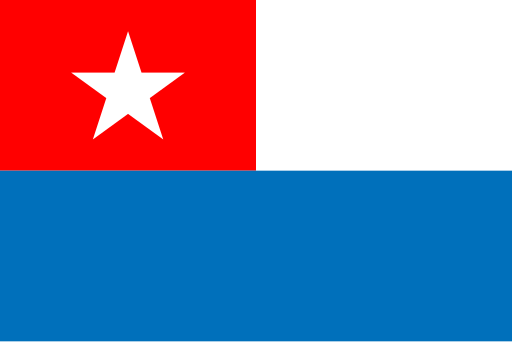
Demajagua Flag (1868)
Raised by Carlos Manuel de Céspedes in 1868 at the start of the Ten Years’ War against Spanish rule. The design featured a red upper field and blue lower field with a white star, along with a vertical white stripe on the right edge.
Although López’s Lone Star design was later chosen as the national banner, the Demajagua Flag remained an important historic symbol of the uprising and was later adopted as the Naval Jack of Cuba.
History of the Cuban flag
The Cuban flag was designed in 1849 during the early movement for independence from Spain.
It was created by poet Miguel Teurbe Tolón in collaboration with Venezuelan-born Cuban revolutionary Narciso López, who had become a leading advocate for Cuban independence while living in exile in the United States.
The first flag was sewn by Emilia Teurbe Tolón, Miguel’s wife.
First raising of the flag (1850)
The flag was first raised on May 19, 1850, in the town of Cárdenas, when López led a failed expedition aimed at liberating Cuba from Spanish rule.
Although the uprising was unsuccessful, the design became a lasting symbol of Cuban independence.
Adoption during the Ten Years’ War (1869)
Cuba’s first major war for independence began in 1868 with the Grito de Yara uprising.
In April 1869, the Congress of the Republic of Cuba met in Guáimaro during the Ten Years’ War and officially designated López’s “Lone Star” flag as the national banner of the Cuban insurgent government.
At the time, Cuba was still under Spanish control, but the flag represented the political identity and aspirations of the independence movement.
Independence and official state adoption (1902)
After the Spanish–American War (1898), Spain relinquished control of Cuba. Following a period of US military administration, Cuba formally became an independent republic on May 20, 1902.
On that day, the Lone Star flag was raised in Havana as the official national flag of the sovereign Republic of Cuba.
Formal specifications (1906)
In 1906, President Tomás Estrada Palma formally established the flag’s design specifications by decree, including its proportions and color standards.
Prior to formal standardization, the shade of blue varied in different reproductions and was often lighter.
The blue was now defined as azul turquí, a deep, saturated shade.
The flag after 1959
Following the Cuban Revolution of 1959, which brought Fidel Castro to power, the national flag remained unchanged.
The design originates from the 19th-century independence movement against Spain and predates the modern Cuban state.

Caitriona Maria is an education writer and owner of The Facts Institute. With seven years of teaching experience and a background in educational content, she specialises in creating clear reference resources about countries, geography and global topics.