A brief overview of the meaning, history, and key facts about the national flag of Gabon.
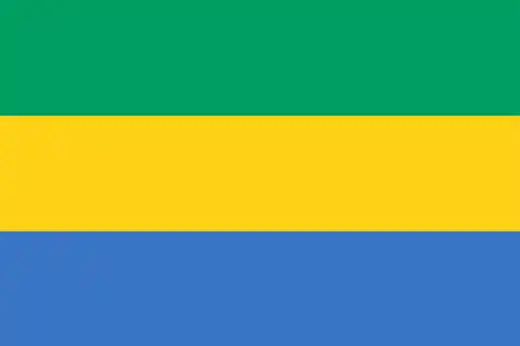
Flag of Gabon
The national flag of Gabon consists of three horizontal stripes: green at the top, yellow in the center, and blue at the bottom. Each color reflects an important feature of the country. The green stripe represents the equatorial forests that cover much of Gabon’s territory and symbolize fertility and agricultural wealth. The yellow stripe represents the Equator, which crosses the country from west to east, as well as the sun and the country’s mineral resources. The blue stripe represents the sea along Gabon’s coast, as well as the many rivers that flow through the country and the sense of peace associated with the nation.
Printable Gabon Flag (PNG Download)
Interesting facts about Gabon’s flag
1. Gabon adopted its current national flag in 1960, the year the country gained independence from France.
2. Before independence, a 1959 version of the flag already used the same green, yellow, and blue stripes but included the French tricolor in the canton. This symbol was removed shortly before independence.
3. The proportions of the Gabonese flag are 3:4, which is relatively uncommon among national flags.
4. Unlike many African national flags, Gabon’s flag does not use the pan-African colors red, yellow, and green together, and instead features a horizontal tricolor design.
5. According to an official government explanation, the yellow stripe also symbolizes “the legendary hospitality of the Gabonese population.”
Explore more about Gabon:
Evolution of Gabon’s flag
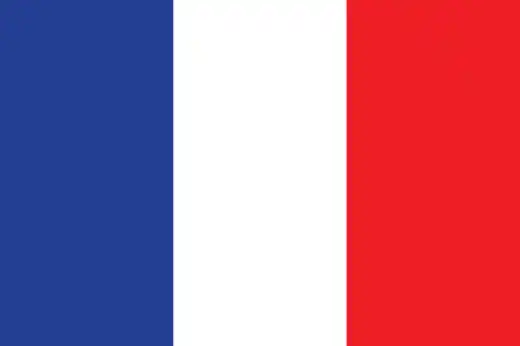
Flag of France (colonial period – 1959)
Before autonomy and independence, Gabon was part of French Equatorial Africa and used the French tricolor as its official flag.
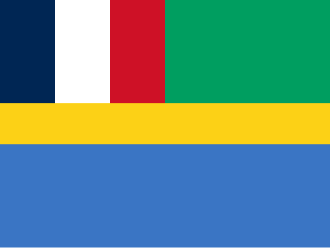
Flag of Gabon (1959–1960)
The Gabon flag featured the green, yellow, and blue horizontal stripes used today, but the yellow stripe was narrower, and the French tricolor appeared in the canton as a symbol of the country’s political connection with France.
History of Gabon’s flag
French colonial rule
France established control over the territory of modern-day Gabon in the 19th century, and the region later became part of French Equatorial Africa, a federation that also included Moyen-Congo (now the Republic of the Congo), Oubangui-Chari (now the Central African Republic), and Chad.
During this period there was no separate colonial flag, and the French tricolor was used as the official symbol of the territory.
Creation of the national flag
As decolonization movements spread across Africa in the late 1950s, Gabon gained greater political autonomy.
In 1959, the country adopted a national flag that combined the colors green, yellow, and blue, symbolizing Gabon’s forests, the Equator and the sun, and the sea along its coast.
The design was slightly modified in 1960 when the French tricolor was removed from the canton and the central yellow band was widened.
Continued use of the flag
Since independence in 1960, the flag has remained unchanged.
The Gabonese constitution defines the national emblem as a tricolor flag composed of three equal horizontal stripes of green, yellow, and blue, reflecting key aspects of the country’s geography and national identity.

Caitriona Maria is an education writer and owner of The Facts Institute. With seven years of teaching experience and a background in educational content, she specialises in creating clear reference resources about countries, geography and global topics.