A brief overview of the meaning, history, and key facts about the national flag of Canada.

Flag of Canada
Adopted in 1965, the Canadian flag is vertically striped red-white-red with a red maple leaf in the center. Red and white are the national colors, and the maple leaf has long been a Canadian national symbol and has been used to represent the Canadian identity since the 19th century.
Printable Canada Flag (PNG Download)
Interesting facts about Canada’s flag
1. Canada is the only country whose national flag features a maple leaf.
2. The red and white national colors are often linked to Canada’s landscape, with white representing snowy winters and red reflecting the vivid maple leaves seen in autumn.
3. The adoption of the maple leaf design followed a heated political battle known as the “Great Flag Debate.” Between 1963 and 1964, Parliament argued intensely over whether Canada should keep elements of the British Union Jack or adopt a new symbol. After 37 days of debate and more than 5,900 public design submissions, the single-leaf design was approved on December 15, 1964.
4. The maple leaf was originally designed with 13 points, but it proved difficult to recognize from a distance or in windy conditions. It was later simplified to 11 points to improve clarity.
5. The Canadian flag is horizontally symmetric thanks to its carefully stylized maple leaf, meaning the top and bottom halves mirror each other across a horizontal axis.
6. The flag was first hoisted on February 15, 1965, after Queen Elizabeth II formally approved the design by royal proclamation.
7. The Canadian flag has reached both the highest point on Earth and outer space, carried to the summit of Mount Everest in 1982 by Canadian mountaineer Laurie Skreslet and flown into space in 1984 aboard the Space Shuttle Challenger with Canada’s first astronaut.
Explore more about Canada:
Evolution of the Canadian flag
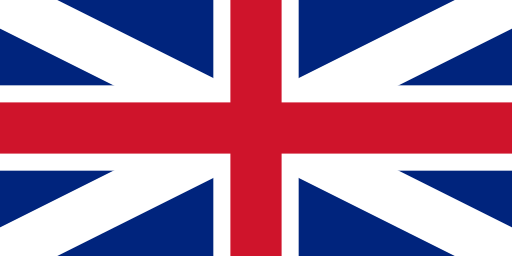
Union Flag (Union Jack)
Canada’s national flag from Confederation in 1867 until 1965. It symbolized Canada’s historical ties to the British Empire and was widely flown across the country before the adoption of a distinct Canadian national flag.
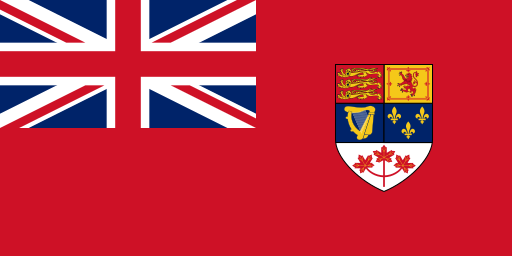
Canadian Red Ensign (19th-20th century)
The Canadian Red Ensign combined the British Union Jack with the shield of the Canadian coat of arms and was widely used on land and at sea.
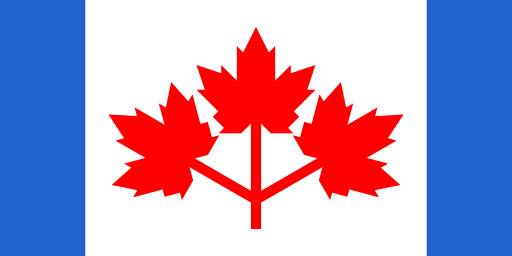
Pearson Pennant (proposed 1964 design)
Proposed by Prime Minister Lester B. Pearson in 1964, this design featured three red maple leaves on a white background bordered by blue stripes.
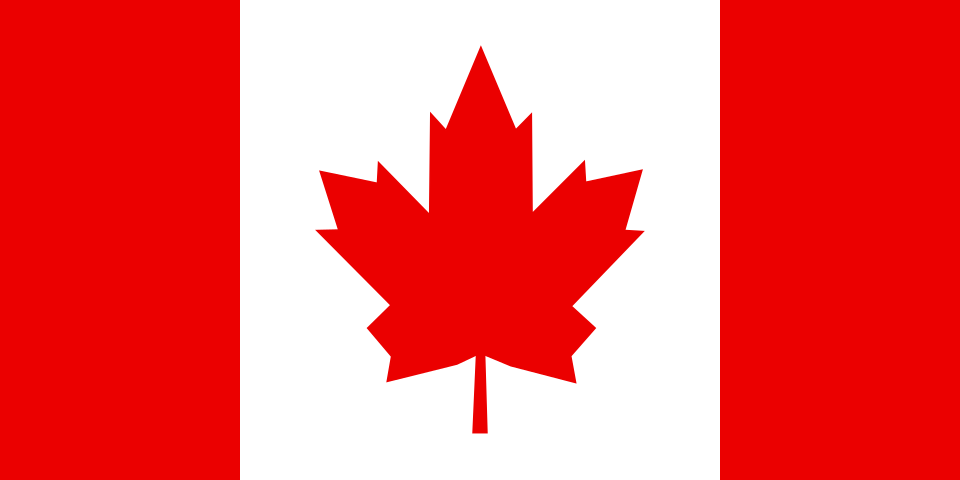
13-point maple leaf prototype (1964)
This early version of the proposed national flag featured a stylized maple leaf with 13 points.
History of the Canadian flag
Early flags and British influence (pre-1965)
Before adopting its current national flag in 1965, Canada used several British-based flags. From Confederation in 1867, the Union Flag, commonly known as the Union Jack, functioned as Canada’s national flag, reflecting the country’s status within the British Empire.
Another widely used symbol was the Canadian Red Ensign, which combined the Union Jack with the shield of the Canadian coat of arms.
Although never formally adopted as the official national flag, it was flown on land and at sea and became closely associated with Canadian identity, particularly during the First and Second World Wars.
As Canada matured as a nation, many citizens began calling for a distinct flag that would better represent Canada’s independence and evolving identity.
The push for a new national symbol (1920s–1950s)
Attempts were made in 1925 and again in 1946 to select a new national flag, but political leaders feared that the issue would divide the country. Many Canadians remained attached to British symbols, while others wanted a uniquely Canadian emblem.
In 1956, during the Suez Crisis, Canadian peacekeepers were mistaken for British forces because they flew the Red Ensign, which incorporated the Union Jack. Incidents like this strengthened arguments for a distinctive Canadian flag.
The Great Flag Debate (1963–1964)
The decisive turning point came under Prime Minister Lester B. Pearson, who pledged to resolve what he called “the flag problem” ahead of Canada’s 100th anniversary in 1967.
Pearson initially proposed a design featuring three maple leaves between two blue stripes, known as the “Pearson Pennant.” However, the proposal sparked intense political controversy. Parliament established a 15-member all-party committee to review nearly 6,000 public design submissions.
Debate was fierce and deeply divisive. Some politicians insisted the Union Jack should remain part of the design, while others supported a completely new symbol. After 37 days of debate, a vote was forced on December 15, 1964.
The committee ultimately selected a design proposed by historian George Stanley: a single stylized red maple leaf centered on a white square, flanked by two red vertical bars.
Stanley’s original concept featured a stylized maple leaf with 13 points. However, testing showed that the detailed leaf lost clarity when viewed from a distance or in windy conditions.
Graphic artist Jacques St-Cyr redesigned the leaf with 11 points to create a cleaner and more recognizable silhouette, which became the final version used on the national flag.
Adoption of the modern flag (1965)
The new design was officially proclaimed by Queen Elizabeth II on January 28, 1965.
On February 15, 1965, the Canadian Red Ensign was lowered on Parliament Hill and the new maple leaf flag was raised for the first time. February 15 is now celebrated annually as National Flag of Canada Day.
The maple leaf itself had long been a national symbol, widely used in military insignia, coins, literature, and patriotic imagery since the 19th century. Its inclusion preserved continuity with Canada’s past while marking a new chapter in its independent identity.

Caitriona Maria is an education writer and owner of The Facts Institute. With seven years of teaching experience and a background in educational content, she specialises in creating clear reference resources about countries, geography and global topics.