A brief overview of the meaning, history, and key facts about the national flag of Guatemala.

Flag of Guatemala
Adopted in 1871, the Guatemalan flag is inspired by the flag used by the Federal Republic of Central America, which consists of blue-white-blue stripes and a coat of arms in the center. According to the Decree, the color white represents peace, purity, integrity, firmness, and light, while blue expresses strength, justice, truth and loyalty. The coat of arms features crossed swords representing justice and sovereignty, laurel branches symbolizing victory, a parchment commemorating the nation’s independence date, and the quetzal, which stands as the ultimate emblem of freedom.
Printable Guatemala Flag (PNG Download)
Interesting facts about the Guatemala flag
1. In 1871, Guatemala changed the traditional Central American horizontal stripes to vertical blue–white–blue to distinguish its flag from El Salvador, Honduras, Nicaragua, and Costa Rica.
2. The blue and white colors come from the 1823 United Provinces of Central America flag, which once united several Central American nations.
3. The coat of arms features the national bird, the quetzal. This bird has been revered since the time of the ancient Maya and Aztecs.
4. Guatemala is one of the few national flags that includes firearms. The coat of arms displays crossed Remington Rolling Block rifles, symbolizing Guatemala’s readiness to defend its sovereignty.
5. The scroll in the coat of arms bears the date September 15, 1821 — the day Central America declared independence from Spain.
6. Guatemala is one of only five countries whose national flag has a width-to-length ratio of 5:8, the others being Argentina, Palau, Poland, and Sweden.
7. Guatemala celebrates Flag Day every year on August 17, during which educational institutions across the country pay homage to the flag.
Explore more about Guatemala:
Evolution of the Guatemala flag
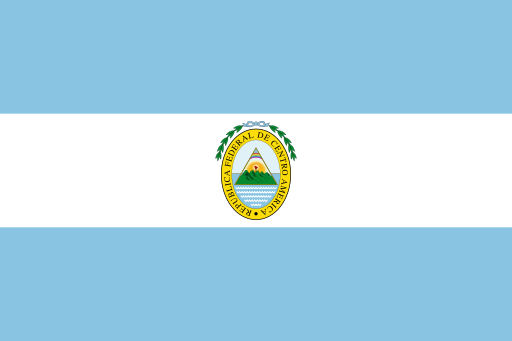
Flag of the Federal Republic of Central America (1823–1841)
The flag of the Federal Republic of Central America consisted of three horizontal stripes of blue, white, and blue. In official versions, the national coat of arms appeared in the center of the white stripe.
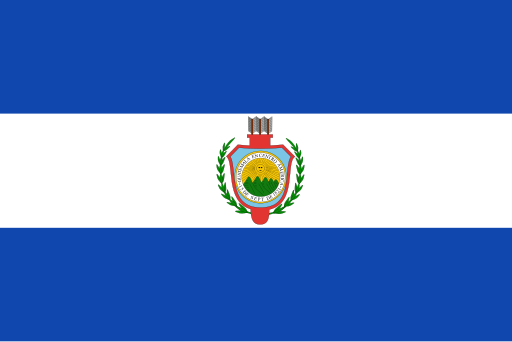
Early Guatemala flag (1843 version)
This early Guatemalan flag featured horizontal blue–white–blue stripes with a national coat of arms in the center. The emblem included volcanoes, a rising sun, and symbolic elements reflecting Guatemala’s national identity.
Huhsunqu, CC BY-SA 2.5, via Wikimedia Commons
History of the Guatemala flag
Origins in the Central American Federation (1821–1843)
After gaining independence from Spain in 1821, Guatemala briefly fell under Mexican rule from 1821 to 1823.
Following this period, the Central American provinces joined together to establish the United Provinces of Central America, which was later known as the Federal Republic of Central America. During this time, Guatemala used the federation’s blue–white–blue horizontal flag.
Political tensions between Liberal and Conservative factions eventually led to civil war, and between 1838 and 1841 the federation dissolved. As a result, Guatemala began adopting its own distinct national symbols.
Early national flags (1843–1871)
On November 14, 1843, Guatemala introduced a new national flag featuring horizontal blue–white–blue stripes and a coat of arms that included volcanoes, a rising sun, and a quiver of arrows. Over the following decades, several variations of the flag and coat of arms were used.
In 1851, after political changes in the country, red and yellow — the traditional Spanish colors — were added to the flag. However, this design did not remain permanent.
Adoption of the modern design (1871)
On August 17, 1871, Guatemala restored the original blue and white colors but changed the stripes from horizontal to vertical. This adjustment helped distinguish Guatemala’s flag from those of El Salvador, Honduras, Nicaragua, and Costa Rica, which retained horizontal stripes.
The new coat of arms featured the resplendent quetzal as its central symbol, resting on a scroll bearing the date of Central American independence: September 15, 1821. The design also included crossed rifles, crossed swords, and laurel branches.
Standardization and modern use (20th century–present)
Although artistic variations of the coat of arms existed for decades, the current official design was formally standardized on September 15, 1968. A minor modification was later made on December 26, 1997.
In 2008, a separate banner known as the Bandera de los Pueblos (Flag of the Peoples) was legally adopted to represent the country’s indigenous communities. It is displayed alongside the national flag at certain official events.

Caitriona Maria is an education writer and owner of The Facts Institute. With seven years of teaching experience and a background in educational content, she specialises in creating clear reference resources about countries, geography and global topics.