The most interesting facts about Seychelles, from the original Garden of Eden to the world’s largest population of giant tortoises.

Fast facts
Official name: Republic of Seychelles
Population: 133,000 (2025 estimate)
Area: 455 sq km
Capital city: Victoria
Major languages: Seychellois Creole, English, French
Major religions: Roman Catholic, Protestant
Time zone: UTC+4 (Seychelles Time)
Interesting facts about Seychelles
1. Seychelles is an island nation in Africa, located in the Indian Ocean, east of Kenya and northeast of Madagascar.
2. The Seychelles is made up of 115 islands, with most people living on just a few small islands.
3. Seychelles was uninhabited before being discovered by Europeans in the early 16th century. As such, there are no indigenous people in Seychelles.

4. Seychelles is named after Jean Moreau de Sechelles, who was the French finance minister in 1756. It was named by French Captain Corneille Nicholas Morphey.
5. The largest and most developed island of Seychelles is Mahe, which is home to around 90% of the population and the capital city of Victoria.

6. Seychelles was controlled by France (annexed in 1756) until the colony was ceded to Britain in 1814.
7. In 1976, Seychelles became independent with James Mancham as president and France Rene as prime minister as its first leaders.
8. The Seychelles flag is made up of blue, yellow, red, white and green rays spreading from the bottom left corner. The colors of the modern Seychelles flag reflect the main political parties in the country: the Seychelles People’s United Party and the Seychelles Democratic Party.

See how Seychelles’ flag compares to other African flags.
9. Seychelles has been isolated from the mainland for 75 million years and as such now hosts a unique collection of flora and fauna. The islands were once part of the ancient supercontinent Gondwanaland.
10. As such, Seychelles has been described as “the original site of the Garden of Eden”. British Army officer General Gordon of Khartoum made the claim after he visited in 1881. He was specifically referring to the UNESCO-listed Vallée de Mai on the island of Praslin.
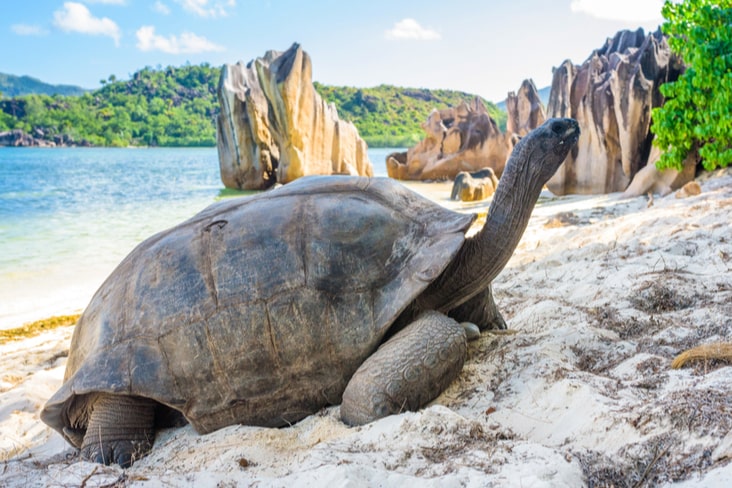
11. Seychelles is home to the world’s largest population of giant tortoises. Over 150,000 live on the UNESCO-listed Aldabra Atoll.
12. Located on Praslin island, the UNESCO-listed Vallée de Mai is an area of palm forest which remains largely unchanged since prehistoric times.
13. The air quality in Seychelles depends on multiple factors, such as wind speed and precipitation. At times, it is excellent, but at other times, it can cause symptoms in sensitive groups.
14. The Seychelles is home to the coco-de-mer (also known as the sea coconut), which bears the largest seed in the plant kingdom.

15. Seychelles has some of the world’s top alcohol consumers per capita. On average, a person consumes 11.4 pure liters per year, the equivalent of 127 bottles of wine!
16. The capital of Seychelles was originally called L’etablissement when it was founded in 1778 by French colonists. The settlement was renamed in 1841 by the British after Queen Victoria.
17. Seychelles is the smallest African country in terms of both area and population.
18. Seychelles is home to the world’s largest land-dwelling arthropod. The Coconut Crab has been nicknamed ‘Crabzilla’ as it can grow up to 1m (3.3ft) in size and weigh up to 4.1kg (9lb) and can even open coconuts.

19. Seychelles is the richest country in Africa when measured by GDP per capita based on purchasing power parity (PPP).
20. It is also ranked as having a very high level of human development, placing 54th out of 193 countries in 2025 and holding the highest position among African nations.
21. Legend has it, buried treasure is hidden in Seychelles and is believed to be worth $130 million. 18th-century French pirate Olivie Levasseur, known as La Buse (“The Buzzard”), is said to have hidden his treasure in Seychelles. Reginald Herbert Cruise-Wilkins spent 27 years searching for the treasure until his 1977 death. Since then, his son John has spent over 50 years continuing the search.
22. During the early 21st century, Somalia pirates began using Seychelles as a safe haven. Pirate sightings and attacks were regularly reported as well as the kidnapping of the British couple while they were sailing the islands.

23. Spead across 1.35 million sq km (521,000 sq miles) of ocean, Seychelles is over 99% water.
24. Seychelles is considered to be one of the safest countries in the world to visit. In 2022, it was assessed as carrying an ‘insignificant travel security risk’.
25. Seychelles also ranked 18th on the 2025 Corruption Perceptions Index (CPI), making it the least corrupt country in Africa.
26. Over the last five years, Seychelles has progressed from protecting 0.04% to 30% of its national waters, covering 410,000 sq km (158,000 sq miles) of ocean – an area larger than Germany.
27. Curried fruit bat is considered a local delicacy in Seychelles.
Explore more: Test your knowledge with our Africa map quiz.
We strive to verify all facts using authoritative and primary sources where possible. However, if you find an error or have any questions, please contact us.

Caitriona Maria is an education writer and owner of The Facts Institute. With seven years of teaching experience and a background in educational content, she specialises in creating clear reference resources about countries, geography and global topics.