Asia is the largest and most diverse continent, covering an area of more than 44.5 million square kilometers (17.2 million square miles), approximately 30% of the Earth’s landmass. The countries in Asia are home to an estimated 4.7 billion people, which accounts for approximately 60% of the world’s population.
This remarkable continent is not only vast but also rich in cultural and religious heritage, being the birthplace of the world’s major religions, including Christianity, Judaism, Buddhism, Hinduism, and Islam.
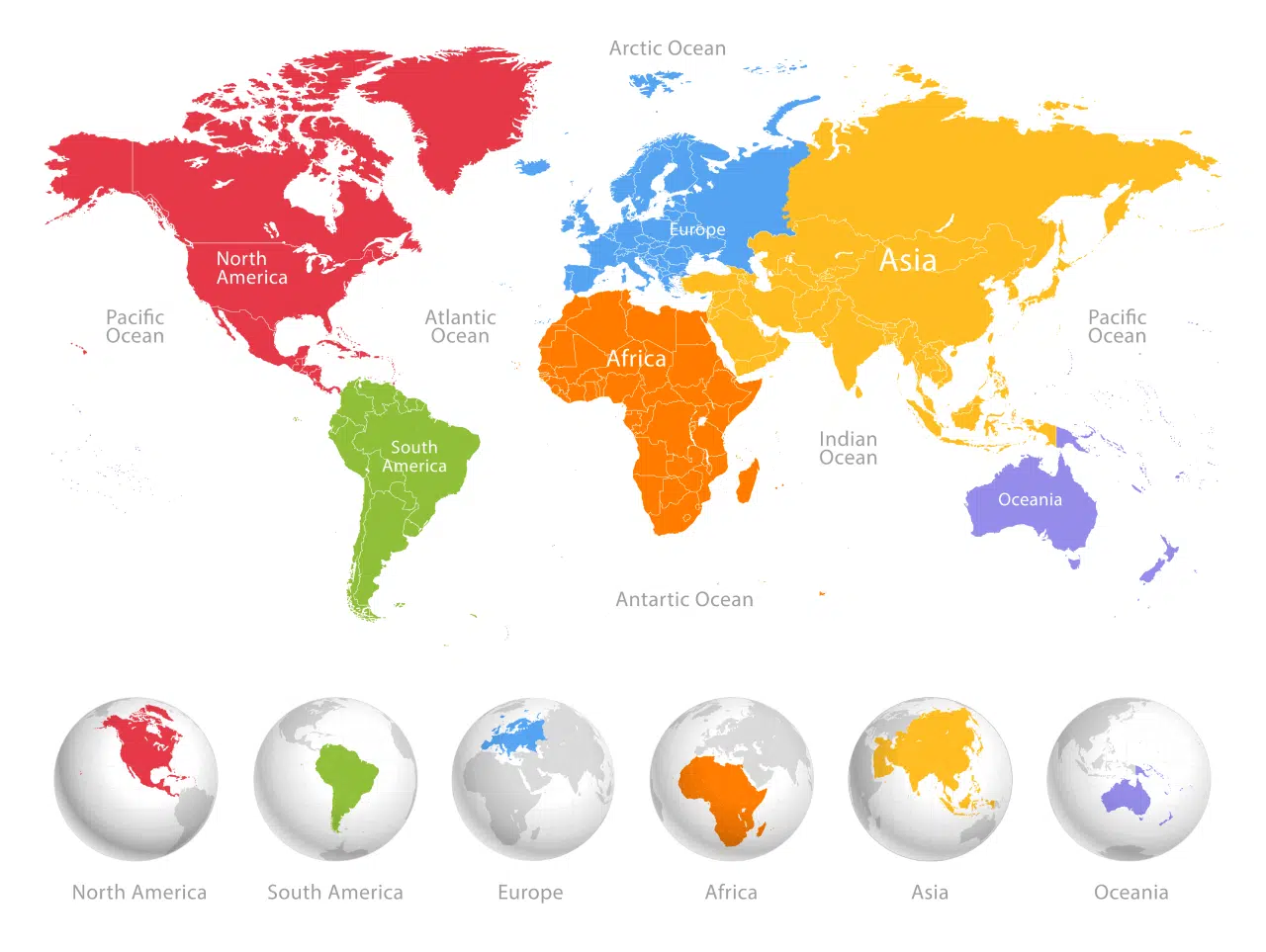
Geographically, the Arctic Ocean bounds Asia to the north, the Pacific Ocean to the east, and the Indian Ocean to the south. This positioning contributes to its diverse climates, ranging from the subarctic conditions found in Siberia to the tropical regions of Southeast Asia.
Asia comprises 49 countries when Palestine is included. The Central Intelligence Agency (CIA) World Factbook lists 48 Asian countries, as it does not count Palestine as a sovereign state. Some sources count 50 when Taiwan is included.
Countries in Asia in alphabetical order
Here is the alphabetical list of Asia country names and their capital cities. We have also included the countries’ regions, the international standard for country codes (ISO 3166), and continents, as they may extend over more than one continent.
🗺️ Looking for a map of all Asian countries with their names and borders? You’ll find it further down the page, or you can jump straight to the map here.
Download: List of Asian countries.
Do you know the countries of Asia?
Loading activity…
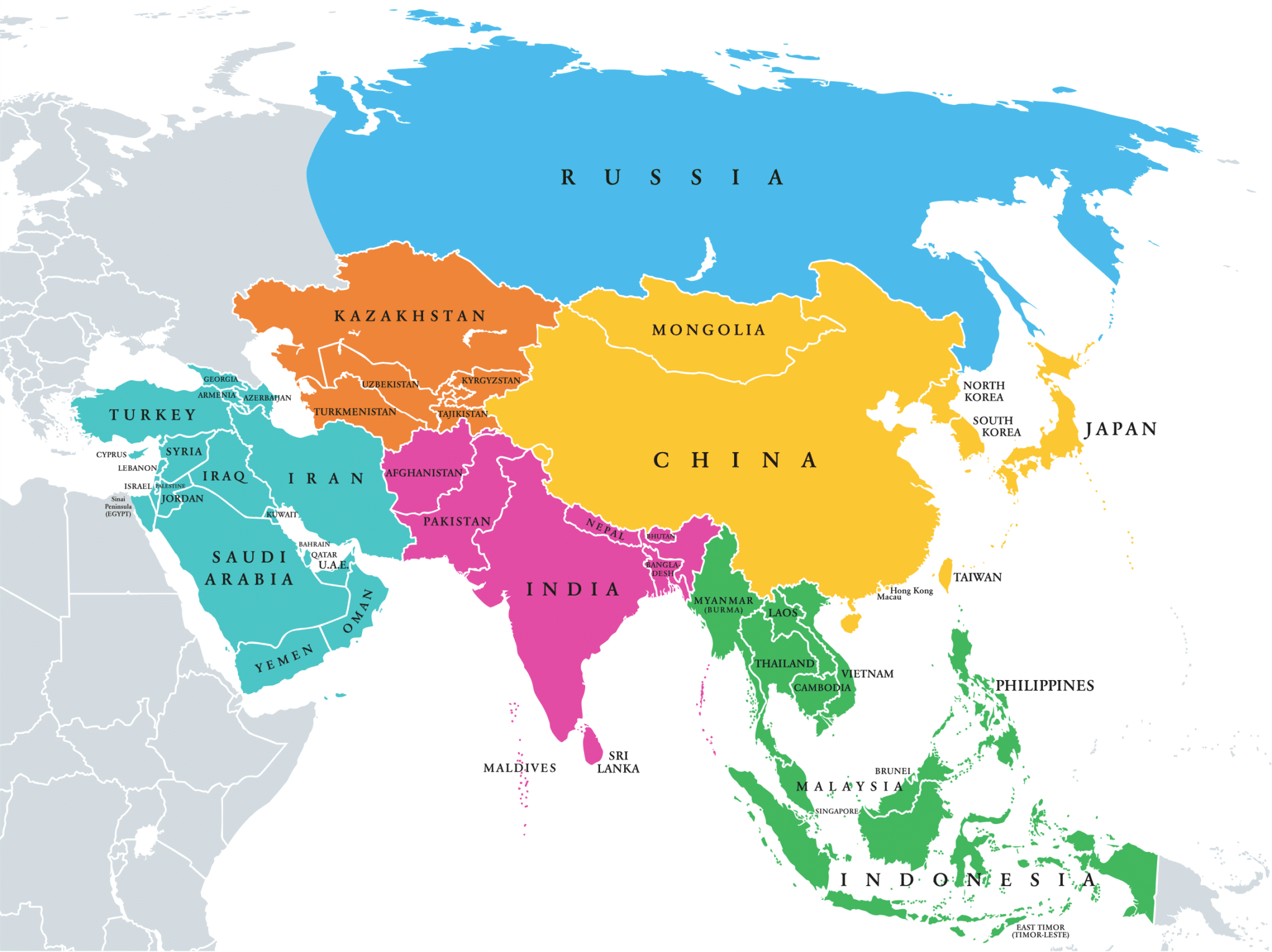
Asia map
Asia is often divided into five regions: East and West Asia, Central Asia, South Asia and Southeast Asia.
Our printable Asian maps show the exact locations of each country.
View their country flags here.
How many countries are in Asia?
There are 48 countries in Asia, according to the CIA World Factbook: Afghanistan, Armenia, Azerbaijan, Bahrain, Bangladesh, Bhutan, Brunei, Cambodia, China, Cyprus, Georgia, India, Indonesia, Iran, Iraq, Israel, Japan, Jordan, Kazakhstan, Kuwait, Kyrgyzstan, Laos, Lebanon, Malaysia, Maldives, Mongolia, Myanmar, Nepal, North Korea (Korea, Democratic People’s Republic of), Oman, Pakistan, Philippines, Qatar, Russia, Saudi Arabia, Singapore, South Korea (Republic of Korea), Sri Lanka, Syria, Tajikistan, Thailand, Timor-Leste, Türkiye (Turkey), Turkmenistan, United Arab Emirates, Uzbekistan, Vietnam, Yemen.
Five of these countries are located across more than one continent. Azerbaijan, Georgia, Kazakhstan, Russia, and Türkiye (Turkey) are also found in Europe.
Egypt is geographically classified as part of Africa, although its Sinai Peninsula lies in Western Asia.
The United States currently does not recognize Taiwan as a sovereign nation. If Taiwan is counted as a separate country, Asia is sometimes listed as having 50 countries.
Related: How many countries are there in the world?
United Nations members in Asia
The United Nations (UN) includes the following states in its Asia-Pacific regional grouping that are geographically located in Asia:
- Afghanistan
- Armenia
- Azerbaijan
- Bahrain
- Bangladesh
- Bhutan
- Brunei Darussalam
- Cambodia
- China
- Cyprus
- Democratic People’s Republic of Korea/North Korea
- Egypt
- Georgia
- India
- Indonesia
- Iran (Islamic Republic of)
- Iraq
- Israel
- Japan
- Jordan
- Kazakhstan
- Kuwait
- Kyrgyzstan
- Lao People’s Democratic Republic/Laos
- Lebanon
- Malaysia
- Maldives
- Mongolia
- Myanmar/Burma
- Nepal
- Oman
- Pakistan
- Palestine
- Philippines
- Qatar
- Republic of Korea/South Korea
- Saudi Arabia
- Singapore
- Sri Lanka
- Syrian Arab Republic
- Tajikistan
- Thailand
- Timor-Leste/East Timor
- Turkmenistan
- Türkiye/Turkey
- United Arab Emirates
- Uzbekistan
- Viet Nam/Vietnam
- Yemen

Caitriona Maria is an education writer and owner of The Facts Institute. With seven years of teaching experience and a background in educational content, she specialises in creating clear reference resources about countries, geography and global topics.

Naa-Atswei Mawufemor Lomo is a content writer who contributes educational articles to The Facts Institute. With a background in communication and digital publishing, she specialises in presenting complex information in an accessible and reader-friendly way.